Amsterdam as a model for Urban Greening
Across the UK, landscaping for developments is too often treated as an ornamental afterthought which resulting in biodiverse poor lawns, sparse planting, or isolated immature trees. It is introduced late to the design process to left-over spaces and is there simply to satisfy planning requirements.
While this gesture planting may technically meet policy requirements, they rarely deliver comprehensive ‘Urban Greening’ i.e. planting that enhances biodiversity and enriches everyday urban life. This is a wasted opportunity and in the context of a growing climate emergency, accelerating biodiversity loss, and declining urban wellbeing, planting within our cites, Urban Greening, should be treated as an essential public infrastructure to achieve the sustainable cities we need.
This article examines how Amsterdam has adopted a nature-first approach to improving the quality of life for its residents. It’s philosophy of Urban Greening has integrated biodiversity, climate resilience, and social empowerment into the fabric of the city. Through a clear policy direction, long-term investment, an emphasis on citizen action and the fostering of ownership, Amsterdam has demonstrated how Urban Greening aspirations move beyond compliance to become a powerful tool for environmental improvement, community pride, and urban sustainability.
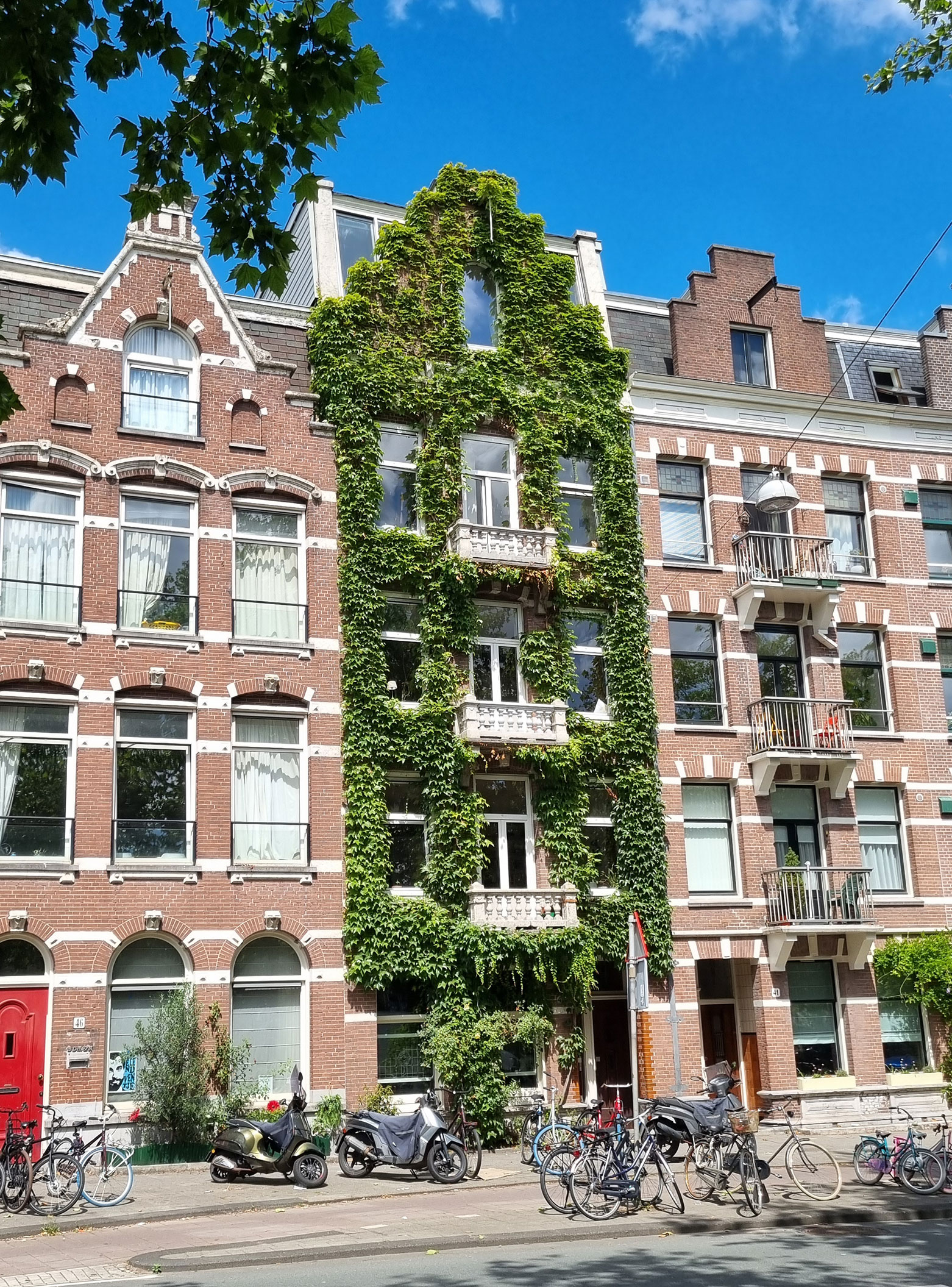
Free cables given out by the city council to encourage residents to grow climbers and occupy the pavement in front of their homes
Urban Greening in the UK: Progress and Limitations
In recent years, the UK government has developed policies intended to promote greener cities and implement the UN’s Sustainable Development Goal 11 for inclusive, safe, resilient, and sustainable urban environments. Both the UK governments 25 Year Environment Plan, introduced in 2018, and it’s Environment Act in 2021 set binding targets for air quality, green space provision, and for biodiversity enhancements to developments through the introduction of the Biodiversity Net Gain (BNG) requirement.
Architects have responded positively, supported by initiatives such as the RIBA 2030 Climate Challenge, while local authorities—particularly in London—have adopted polices to quantify planting and biodiversity provision within developments. Policy G5 of the majors London Plan, for example, requires all major developments in London to incorporate Urban Greening as a fundamental element of site and building design. It is measured by the Urban Greening Factor, UGF for short. The policy requires the provision of biodiverse rich planting, i.e. Urban Greening, in any major development (11 residential units or more for example) and sets a minimum UGF score of 0.4 for residential, and 0.3 for commercial projects. The UGF seeks to quantify the planting incorporated in a development as a percentage of the site area with different weighting for a variety of planting and sustainable choices. This ranges from permeable paving with a weighting of 0.1, to green walls at 0.6, and maintained semi-natural vegetation (e.g. trees, woodland, species-rich grassland) at 1. This policy ensures a minimum level of Greening and therefore bio habitat in all major developments. It has led to more planting generally and in-particular the widespread use of green roofs and green walls.
Yet, despite this planning requirement, the resulting planting often feels like the Greening was viewed as policy compliance rather than a design and sustainability ambition that can be actively embraced by the future residents and uses of the development. For example, the green infrastructure for new urban residential developments is almost always delivered for residents rather than with their aspirations and participation in mind. The planting is frequently biodiverse poor, sparse, inaccessible, and/or heavily controlled. The residents are not given meaningful and exciting opportunities to plant and nourish their environments and so the planting lacks long-term sustainability benefits, stewardship, emotional connection, and ecological richness. The green infrastructure becomes a remote experienced, unloved, and unowned.
The UGF policy only applies to new developments in London and not to existing environments. But to really change our towns and cities, and meet the UN’s Goal 11, we should be looking to integrating and encouraging Urban Greening into existing built environments so we can transform our streets and neighbourhoods.
We cannot build our way out of the climate crises and the biodiversity decline. As designers and policies makers we need to transform the existing environments in all our town and cities and so make more significant sustainability improvements to our urban spaces. Only then can we achieve the aims of the 25-Year Environmental Plan the UN’s Goal 11.
This is the approach the City Council in Amsterdam have taken and it has brought about a transformation of the historic city centre.
Amsterdam: Green by Default
This philosophy is supported by an ambitious long-term green infrastructure vision, Amsterdam’s 2021-2025 Green Investment Plan. which in turn is underpinned by sustained public investment with millions of euros committed to park improvements, tree planting, environmental and biodiversity improvement and the enabling of community action. Amsterdam offers a compelling example through a simple but powerful principle: Green by Default, i.e. wherever feasible, plant and plant for the future.
Streets, verges, parks and building envelopes all become opportunities for planting and biodiversity enhancements.
Wherever feasible, why not plant?
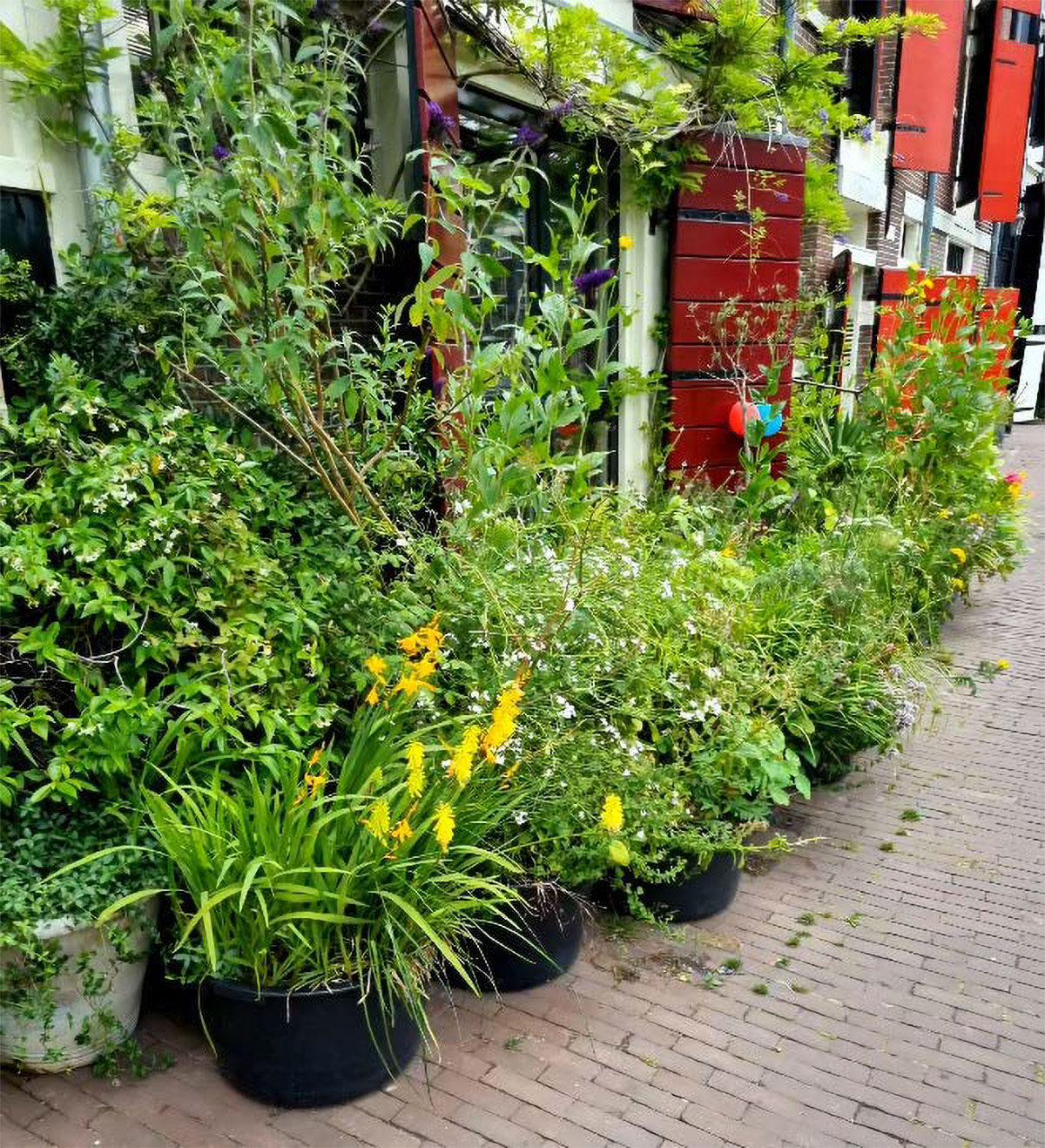
Planters on the pavements
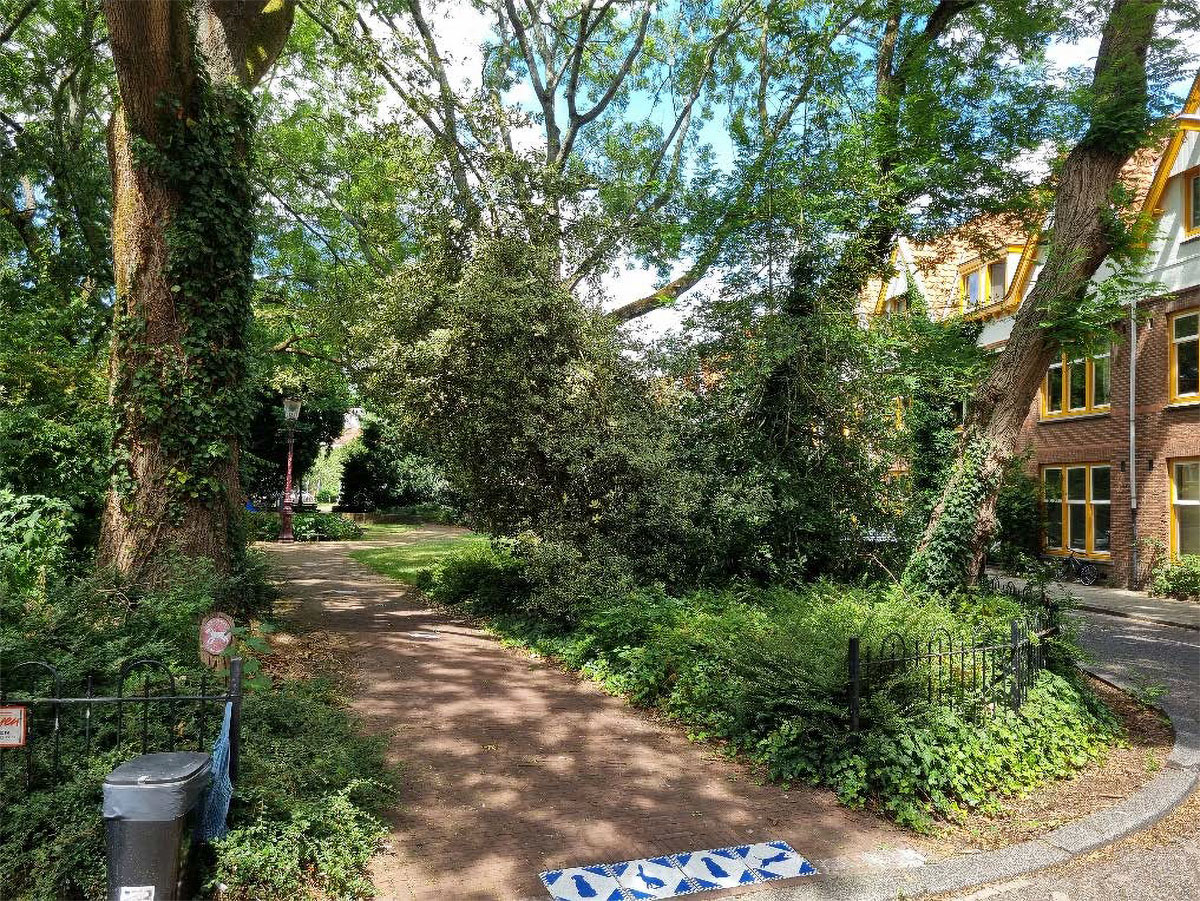
Green neighbourhood formed from reducing road widths
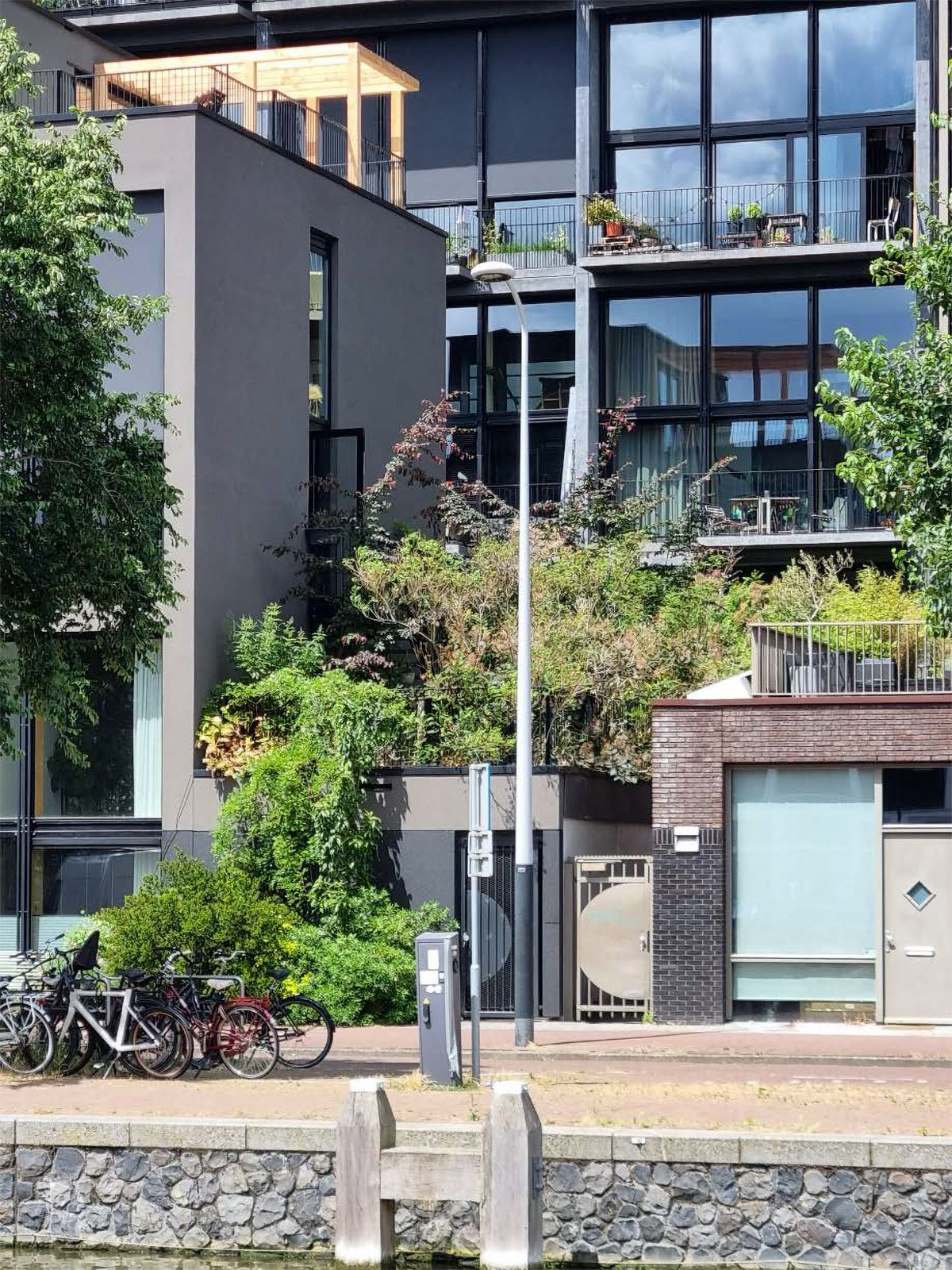
Biodiverse rich planting integrated into new housing
Partnerships have been key in this effort, with over €20 million public investment matched with private contributions to enable nine pilot projects to lead the way and show how biodiverse dead urban spaces can be transformed into rich urban parks full of planting. For example, the Martin Luther Kingpark, previously an urban square dominated by traffic and trams is now a green oasis, and the transformation of Frederiksplein into Frederikspark, demonstrate how formerly traffic-dominated spaces can become inclusive, biodiverse rich landscapes.
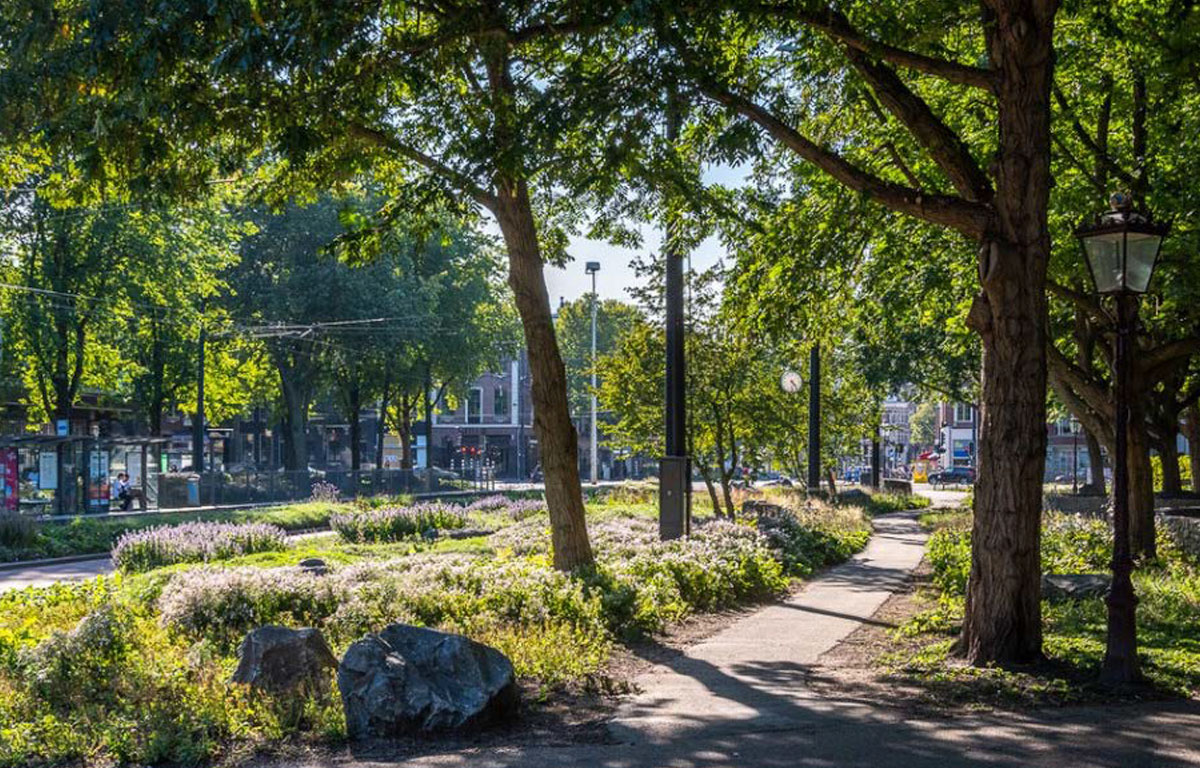
Frderiksplein transformed from a hard paved vehicle dominated square into a biodiverse rich urban park
Crucially, the policies enacted in Amsterdam are not solely focused on delivery, but on enabling action and their strategy for Urban Green can be distilled into five principles
- Designing buildings around planting and with planting integrated into their fabric.
- Neighbourhood-scale Greening led by resident action and community ownership.
- New ‘Green’ routes forming linear ecological rich connections across the city.
- New biodiverse parks created from both sterile urban spaces and the existing underperforming parks.
- Green streetscapes formed by replacing hard infrastructure with planting and permeable surfaces.
Amsterdam’s polices have made real Greening improvements over the last five years. Planting has become widespread through breaking the dominance of the car and replacing paving with planting. As part of these works cycling infrastructure has been improved, and they have enabled residents to reclaim their neighbourhoods. This has strengthened social cohesion and fostering a sense of ownership and pride alongside the improved environmental and ecological value of forming Green streetscapes, neighbourhoods, and routes.
A defining characteristic of Amsterdam’s success is the significant role played by its citizens. The City Council have actively removed barriers to participation and offering practical support such as:
- Free stainless-steel cables to enable climbing plants on facades
- Tax incentives for developments incorporating blue-green roofs
- Free trees for residents, including a “new baby tree” scheme.
- Introducing a right to plant to allow residents to use and ’own’ the pavement in front of their homes.
By giving residents, the opportunity to take over their neighbourhood responsibility for the Greening of the city has become a shared objective, personal to the residents. City wide Greening is being achieved through thousands of small actions, the planting of pots, the installation of climbers and the formation of planting beds. These are personal improvements, loved and cared for by the residents in many ways they are the most noticeable of all the Greening improvements as they are individualistic and unique. They give variety and character and importantly it has mobilised an army of Greening voluntaries.
This sense of ownership fosters pride, stronger communities long-term stewardship of the Greening, outcomes that regulations can not achieve and the city council can not afford.
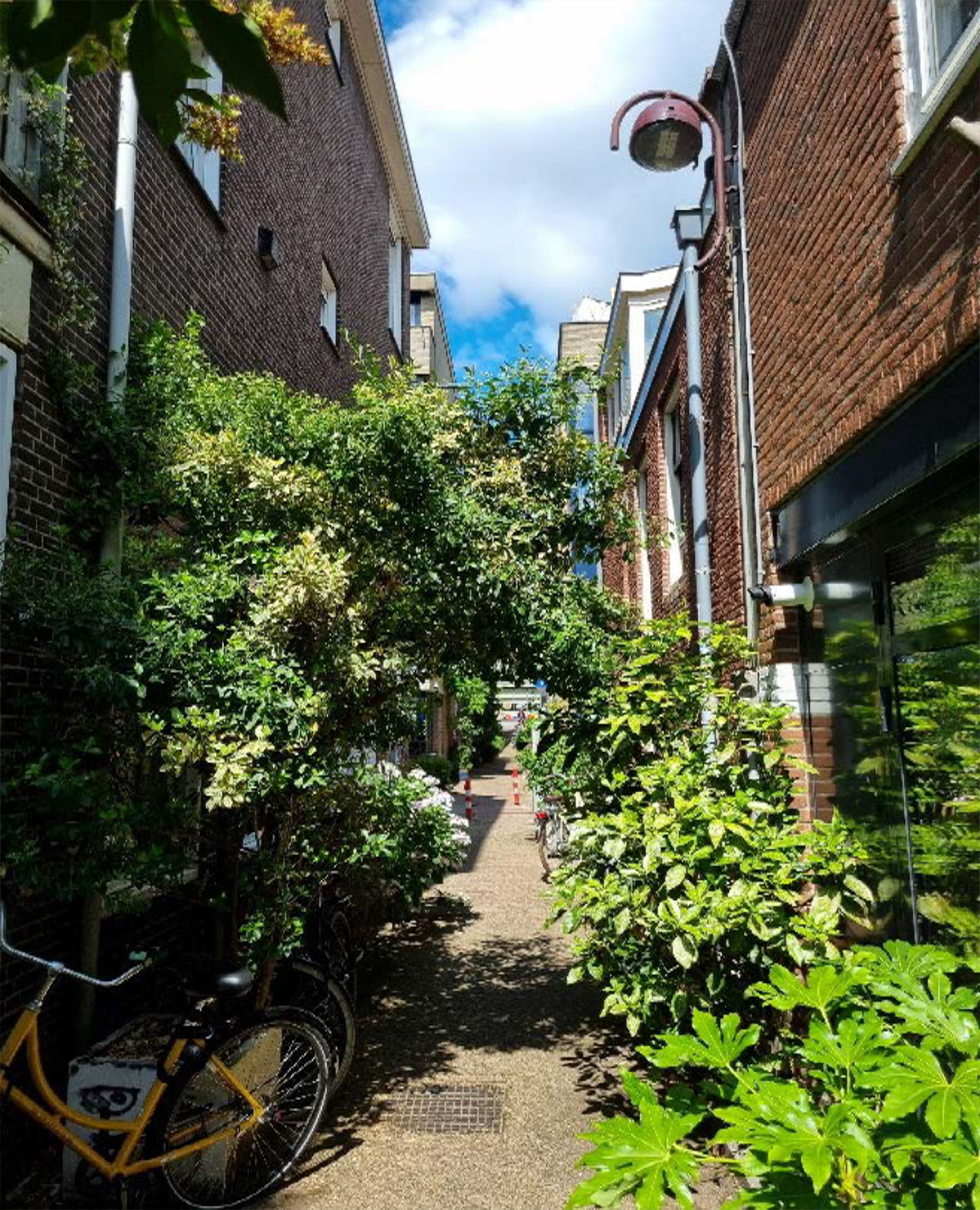
Residential street turned into an urban garden by its residents
Design for Biodiversity, Not Ornamentation
In the UK, we more than often designed planting to be low maintenance, formal or defensive. The ‘planting schemes’ are the result of Secure By Design requirements for defensible zones, the planner’s requirements for privacy or separation and the developer's requirements for low maintenance.
Amsterdam however has focused on planting for biodiversity, it is neither neat or controlled, but it does invites wildlife such as bees and insects to make it their home. They use natural planting where possible, as seen in their park transformations where wildflowers replace grass or in their playgrounds where the swings and roundabouts sit between hillocks of sand covered with wild grasses and scrub.
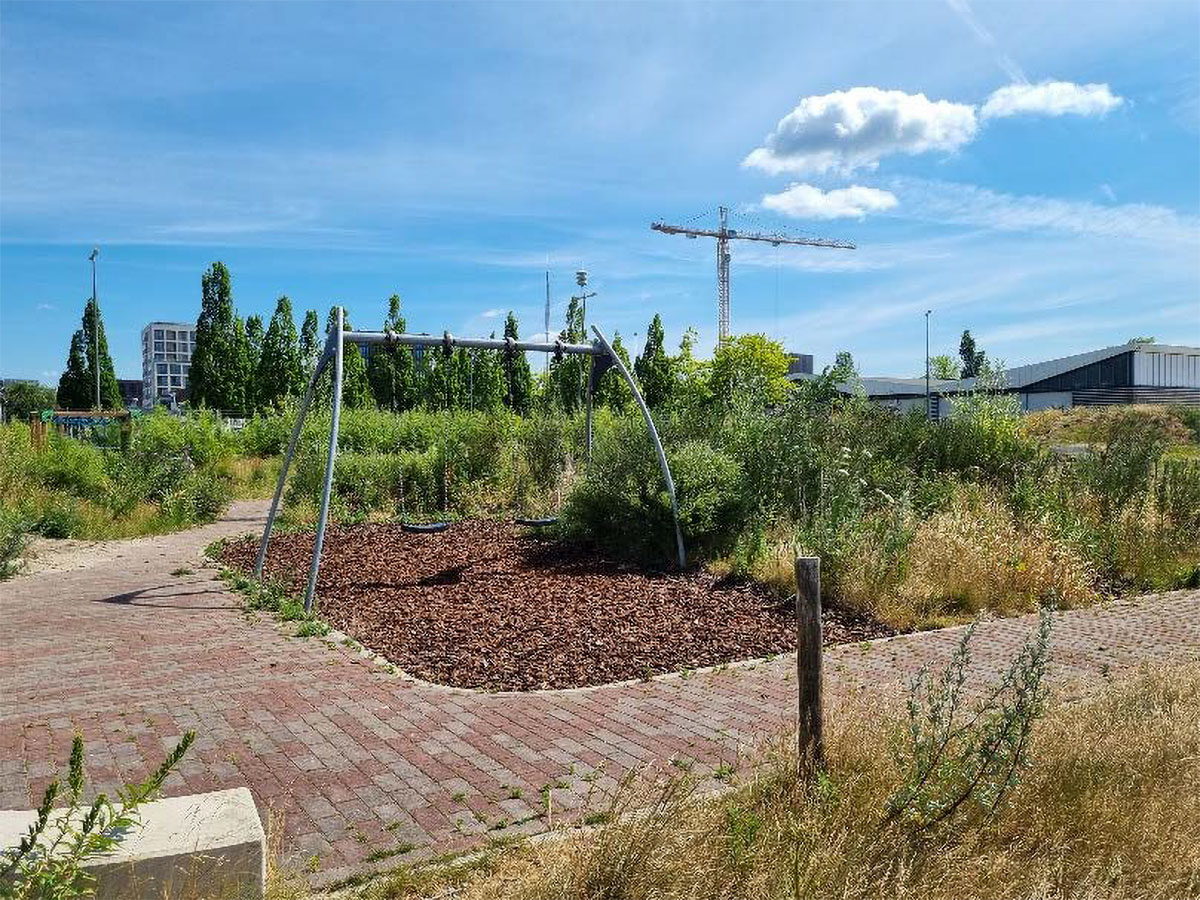
Playgrounds with wilding planning and sand mounds
The prioritising of ecological performance over formal aesthetics can be seen throughout the developed docks of Noord where verges are now ribbons of wildflower meadows shaded by trees. The city planners have incorporated cycle routes and footpaths into the planting to form the Green routes connecting the new developments to parks and the city centre.
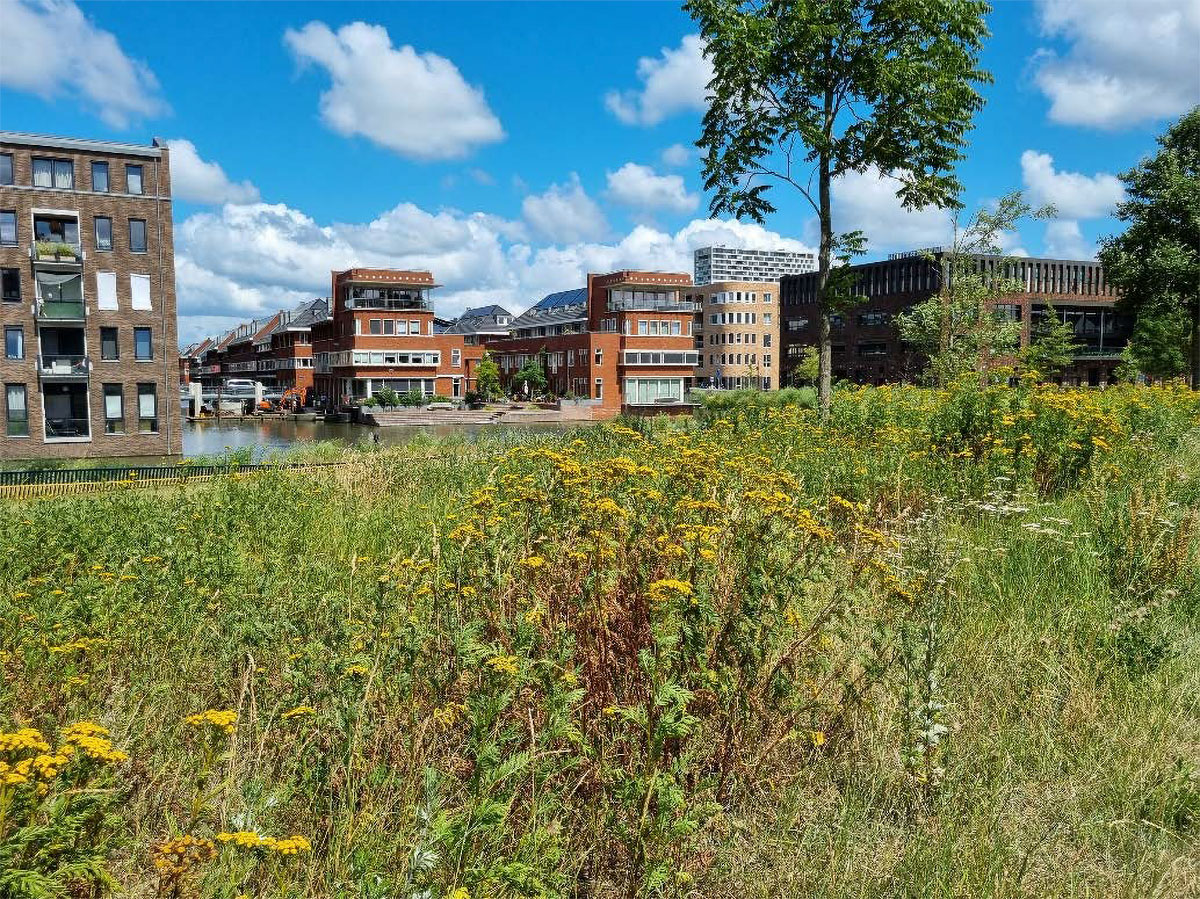
Wild planted verges in areas of new developments, Noord, Amsterdam
New civil engineering is also seen as an opportunity for Greening and incorporate space for planting and natural habitats.
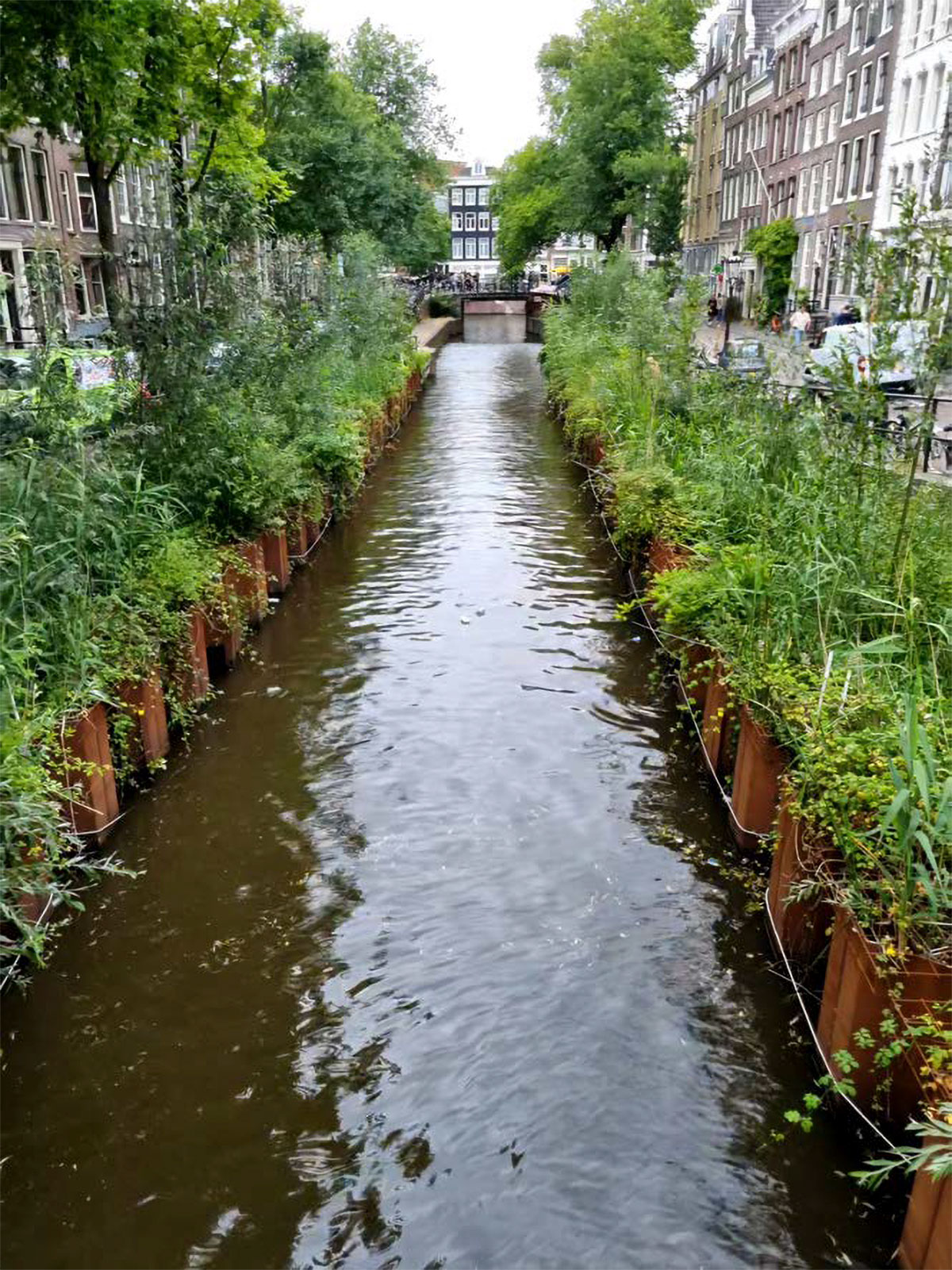
Reinforcement of a canal used as an opportunity for Greening.
This approach delivers measurable benefits such as improved air quality, reduced urban heat island effects, better surface water management and a more resilient urban ecosystem. It also delivers fewer tangible benefits for the residents through better well being and mental health.
It challenges traditional notions of what an urban landscape should look like, legitimising a more natural, productive aesthetic.
Green routes have extended into the historic, dense urban areas of the city through the formation of communal Garden Streets. These has been achieved by converting the residential roads into one-way systems and reducing parking spaces. This gives space for the planting of trees, wildflowers, cycle stands and space for the residents to take ownership of the pavements with pots, benches and mini front gardens.
Along side these physical changes cycling has been promoted as the cities main form of transport, if you cycle, everything and everyone gives way, cars (and often pedestrians) are secondary. The council have provided cycle parking and routes throughout the city and as a result the residential roads have become largely traffic free.
Who would not want to always be within a 10-minute cycle to a park, connected by ribbons of wild planting and shady trees?
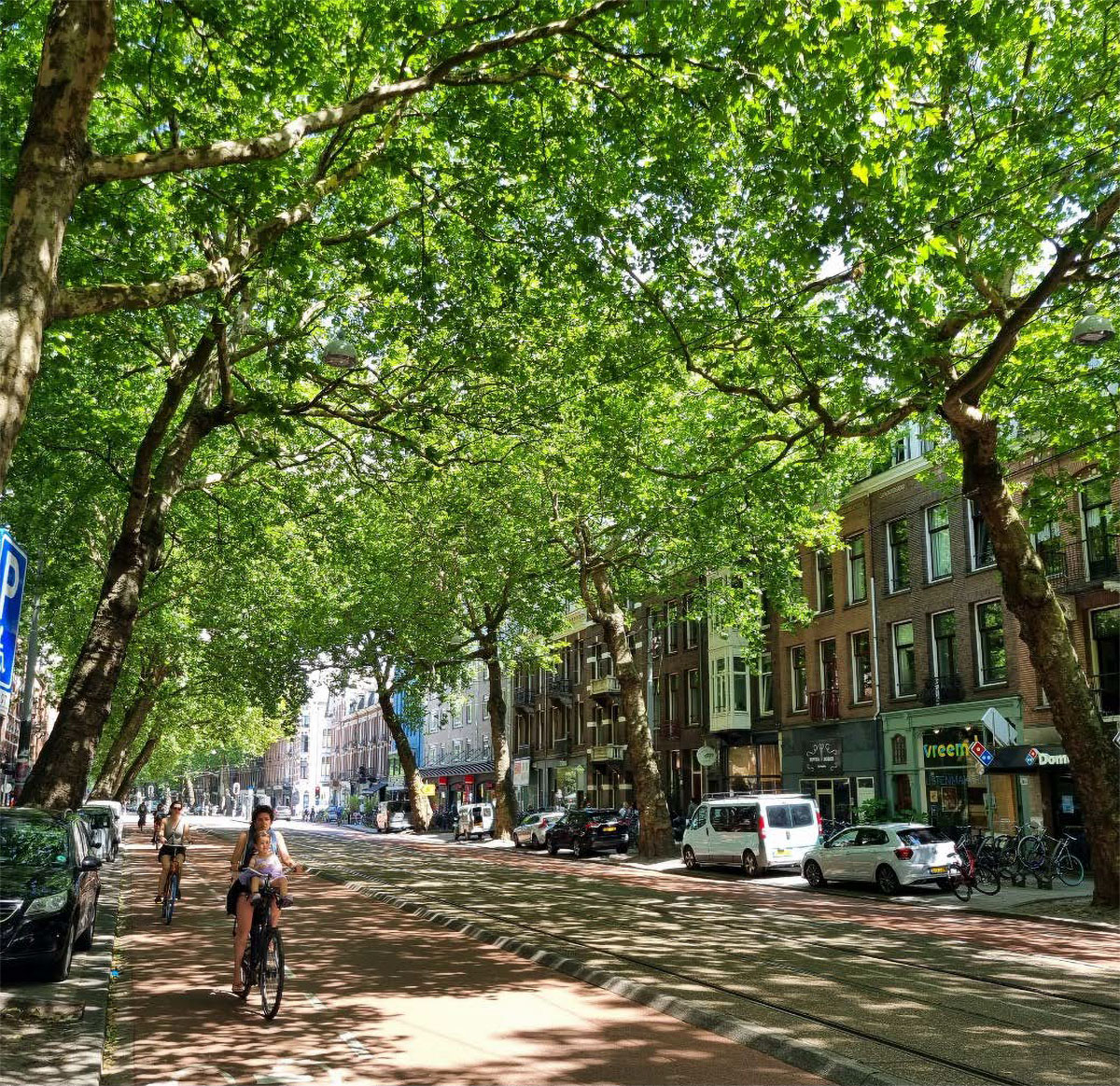
Shading streets with priorities cycle lanes around the historic centre of Amsterdam
The progress Amsterdam has made has been transformative and has been achieved through not only implementing policies and environmental improvements but more importantly though enabling individual and community action, Micro-Greening.
Amsterdam has made it easy for the city’s residents to collaborate with the Greening. They have fostered a stronger sense of ownership and community, and so more loved greener spaces and neighbourhood. The residents can take on the responsibility for care in, and nurturing of their green streets and feel empowered to reclaim their neighbourhoods and continue Greening the city.
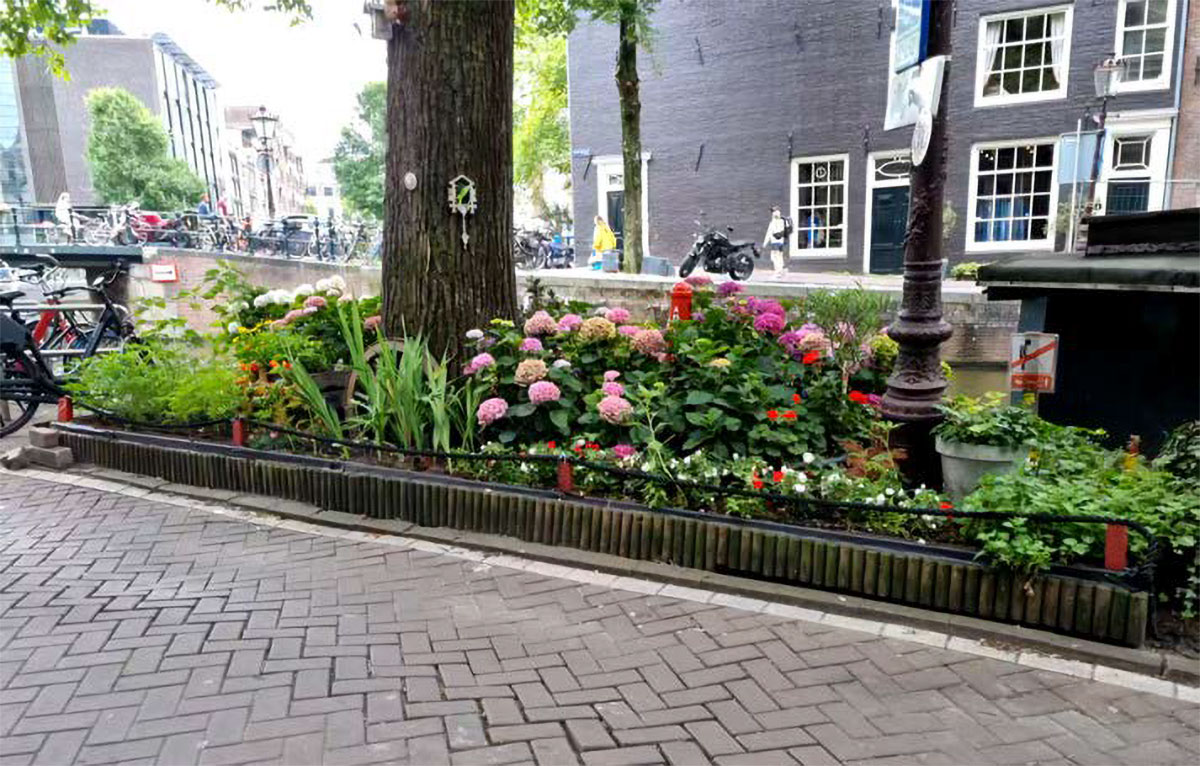
Planting strips taken over, loved and maintained by residents.
The result is an exponential increase in planting through the small individual action of Micro-Greening.
The City Council’s policies have introduced these Urban Greening polices and schemes, but it is the city residents that are at the forefront of the Greening of Amsterdam and there is little reason for them not to green.
Two examples of the policies encouraging this sense of ownership are firstly, the ‘new baby’ tree scheme in Amsterdam. If you have had a baby since 2019 in Amsterdam, the council will give you a free ‘new baby’ tree to plant in your garden, on your balcony, or roof or in pots on the street. This simple and cost affective policy is a thoughtful and beautiful way to spark the residents into more Urban Greening. Over 12,000 ‘new baby’ trees have been planted to date. Furthermore, in late 2024 approximately 7500 free native trees (e.g. spindle, field maple) were distributed to residents, and they have been tracked on a digital interactive map with photos and updates posted by residents.
Secondly, residents have a right to take ownership of the spaces in front of their homes, allowing them to lift paving and plant or to occupying with pots and benches.
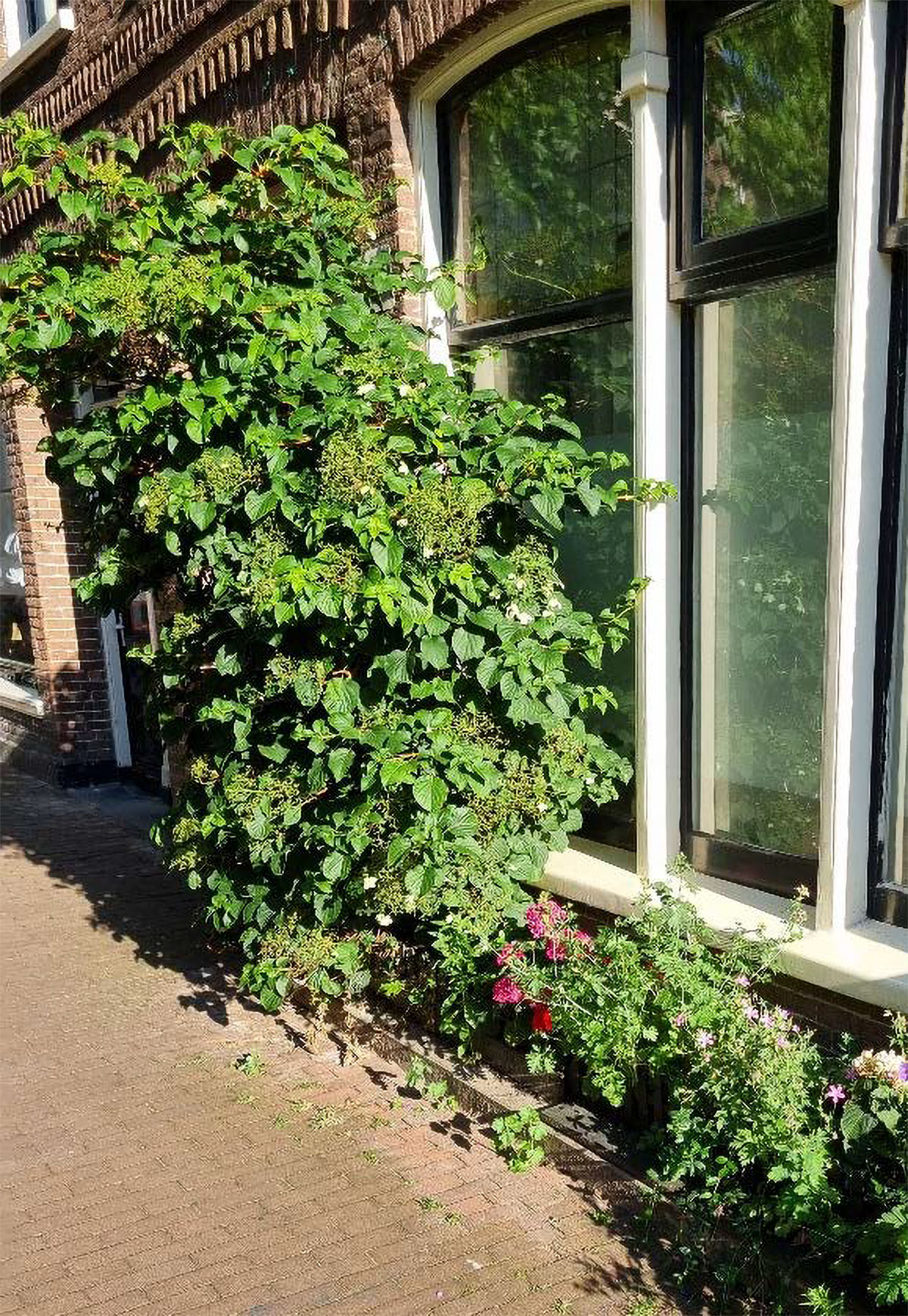
Residents taking ownership of the pavements in front of their homes
In another Dutch city, De Haag, the City Council will even exchange paving blocks from the front of resident's houses for plants.
This gives residents mini front-gardens, opportunities for microgreening, and the power to reclaim their neighbourhoods. It boosts biodiversity with pollinator rich planting, improves their immediate environments and gives the residents a sense of owner over their neighbourhood.
Residents can also take over communal gardens between apartment blocks, dividing them into allotments and small private gardens. This enlivens spaces, maximises community use, and encourages a sense of ownership.
Dutch cities are being transformed one pot at a time.
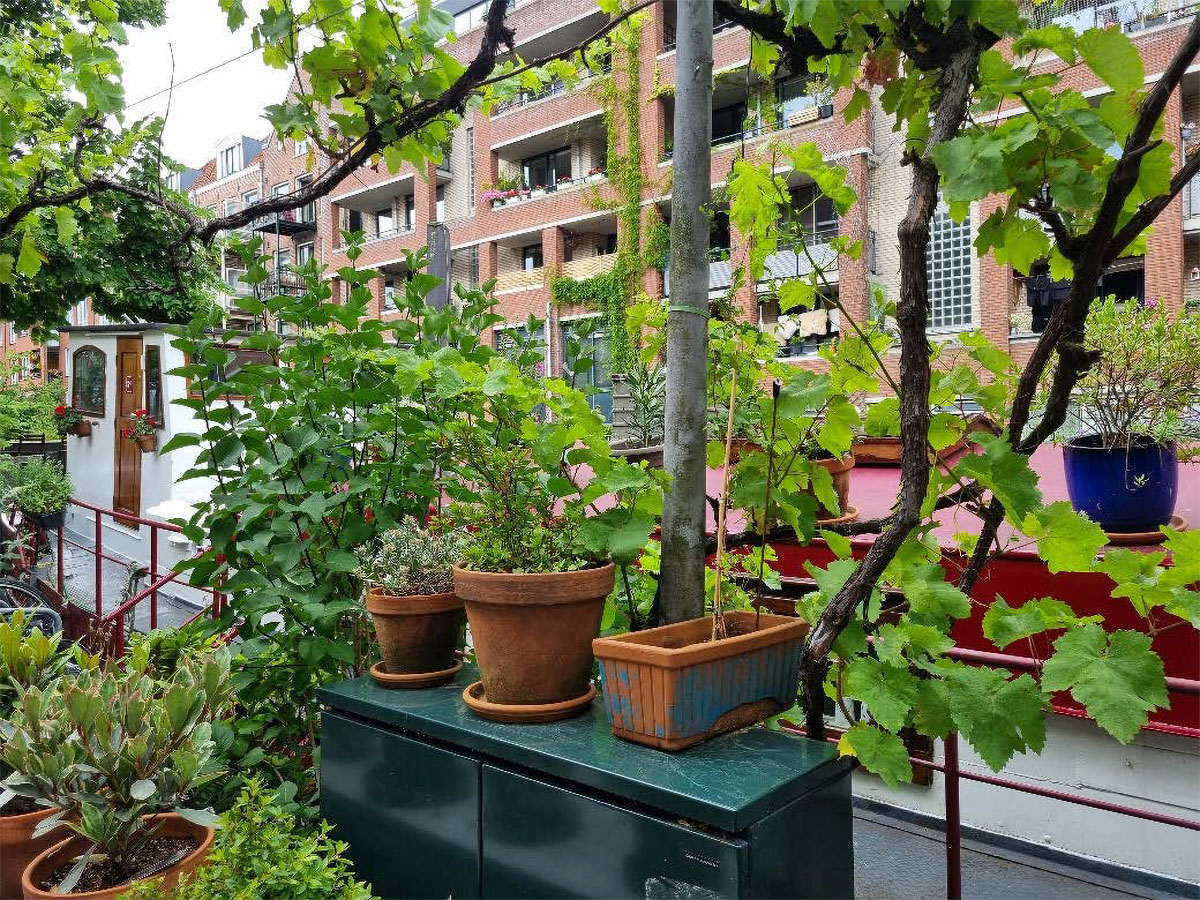
Pots of plants and climbers spilling out onto the street in the historic centre of Amsterdam
What we could learn from Amsterdam
The City of Amsterdam Department of Planning and Sustainability mission statement says
‘We search for new approaches and stimulate bottom-up processes to integrate solutions in the field of urbanisation, mobility, and water management in multidisciplinary teams’.
Amsterdam’s policies not only provide opportunities for Greening, but they insist on a Green by Default approach to developments and urban regeneration projects.
Through straightforward, well-designed policies, the city council have required and empowered professionals and residents alike, ensuring that Urban Greening is not just encouraged but made easy to achieve. In comparison, the UK presents obstacles. The Lambeth Greening Policy is a great example of how difficult it is for residents to Green their neighbourhood. The process of getting permissions and planning approval to transform left over unloved spaces is so convoluted and non-user friendly that even determined citizens give up and why is planning approval required anyway?
Planting is natural, it should be easy!
The UK is taking steps to retain and improve Greening by in new developments, derived from the Environmental Act 2021, the Biodiversity Net Gain (BGN) policy requires a 10% net gain in biodiversity for new developments. To achieve this, a biodiversity baseline survey, detailing the flora and fauna on a site is undertaken and the design team must then take measures for on-site enhancements, including green roofs, ponds, wildflowers, planting for pollinators, trees, and hedgerows that achieve a 10% improvement from this established baseline. If the required biodiversity improvements are not included in the design, off site ‘units’ (payments to increase biodiversity elsewhere) can be made. However, this results in a number of difficulties, particularly agreeing where the money will be spent, resulting in delays to the approval and ‘unspent’ credits by the council.
It is also important to note that BNG improvement requirements for rural areas are higher than they are for sites in urban areas. However, it is our cities that critically need biodiversity improvements more. Could this policy be tweaked? Could the previously mentioned off site ‘units’ be transferred from rural councils to a central ‘bank’ for distribution to urban improvement projects?
There is a growing concern that the UK’s push for biodiversity is beginning to feel more like a chore than an opportunity. When the process of Urban Greening becomes cumbersome, it undermines developer’s best intentions and the very idea of any community-driven action.
If the Greening is made to be difficult, why would people feel empowered to make the changes we need?
To really make a meaningful change to our towns and cities we need new policies, ones that are ambitious enough to easily inspire change. For example, why not encourage green facades and roofs on new and exiting buildings though tax incentives for developers and permitted development rights? Or planning policies that require every new residential apartment to have a planting space built into their balconies?
Council policies should motivate developers and the design teams to put Greening at the forefront of their projects and encourage citizens to lead their own greening efforts. Amsterdam has shown that this is the most effective way to achieve Urban Greening.
To make a real difference to biodiversity and sustainability in our cities we cannot rely on new developments alone, we need policies and actions to improve our existing built environment too.
Initiatives are needed to enable the provision of trees, climbers, and planting for pollinators within our existing urban spaces. We should be removing hard, non-permeable paving and turning streets into Green Linear Parks.
Councils should be required to introduce a Green By Default policy to shape new developments and improvements to the existing building environment alike.
This policy could encourage wild planting in play areas and unloved open spaces to form biodiversity hot spots; with benches forming bee hotels and wildflower meadows. It would set urban tree planting requirements and introduce such measures as requiring trees to be planted as part of permissions for street works.
Another solution could be the transfer of Biodiversity Net Gain credits from rural councils to our cities where they are needed most.
We do have enormous potential with our numerous urban parks and gardens to rethink our approach towards planting and so improve biodiversity. There could be lots of easy wins, such as replacing cut lawns with wildflower planting. Edinburgh has set a great example doing just this as they turn large areas of lawn in Brunsfield Links to wildflower meadows.
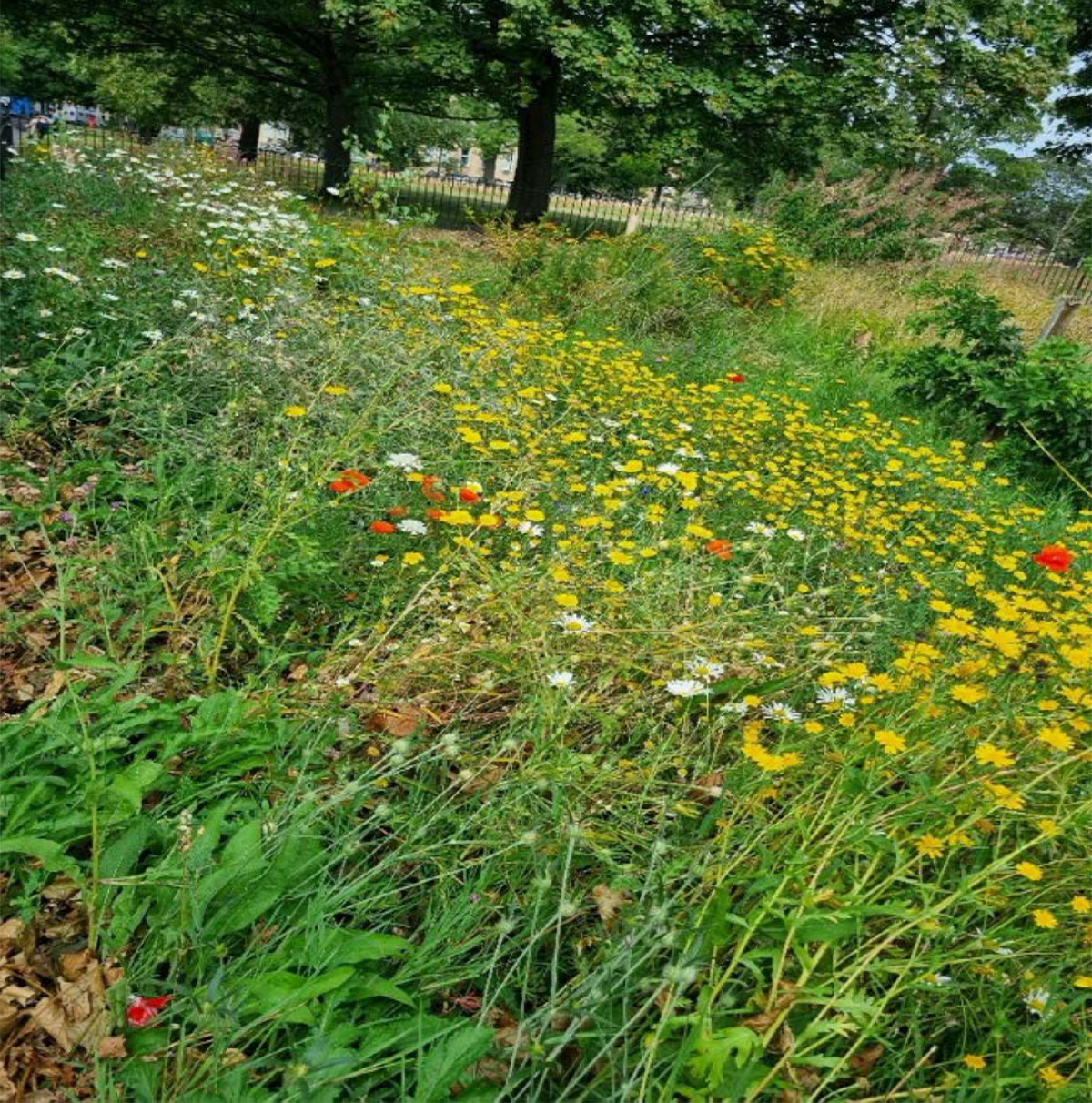
Grassed areas being converted to wildflower meadows in Brunsfield Links
As well as improving our parks we could require councils to have a Green Connection Plan so that they review opportunities for creating biodiverse rich mini spaces and linear green routes which link their residents to parks. These improvements could be paid for by designating Urban Green as an infrastructure requirement so that CIL (Community Infrastructure Levy) fees gathered form developments could be used as funding.
Building designers and developers should look to fully integrated planting into the fabric of the developments. This could be in the form of green roofs and communal spaces, planted facades or balconies with mini gardens. They should look to design buildings around the planting so that it is at the centre of the development not in the spaces left over.
Technical issues will need to be addressed surrounding irrigation and fire risk as the current Building Regulations raise concerns over the combustibility of planting on building facades particularly if irrigation system fails and the plant material dries out. But this can be resolved through designing in ‘fire breaks’ on each floor or by the composition of the façade.
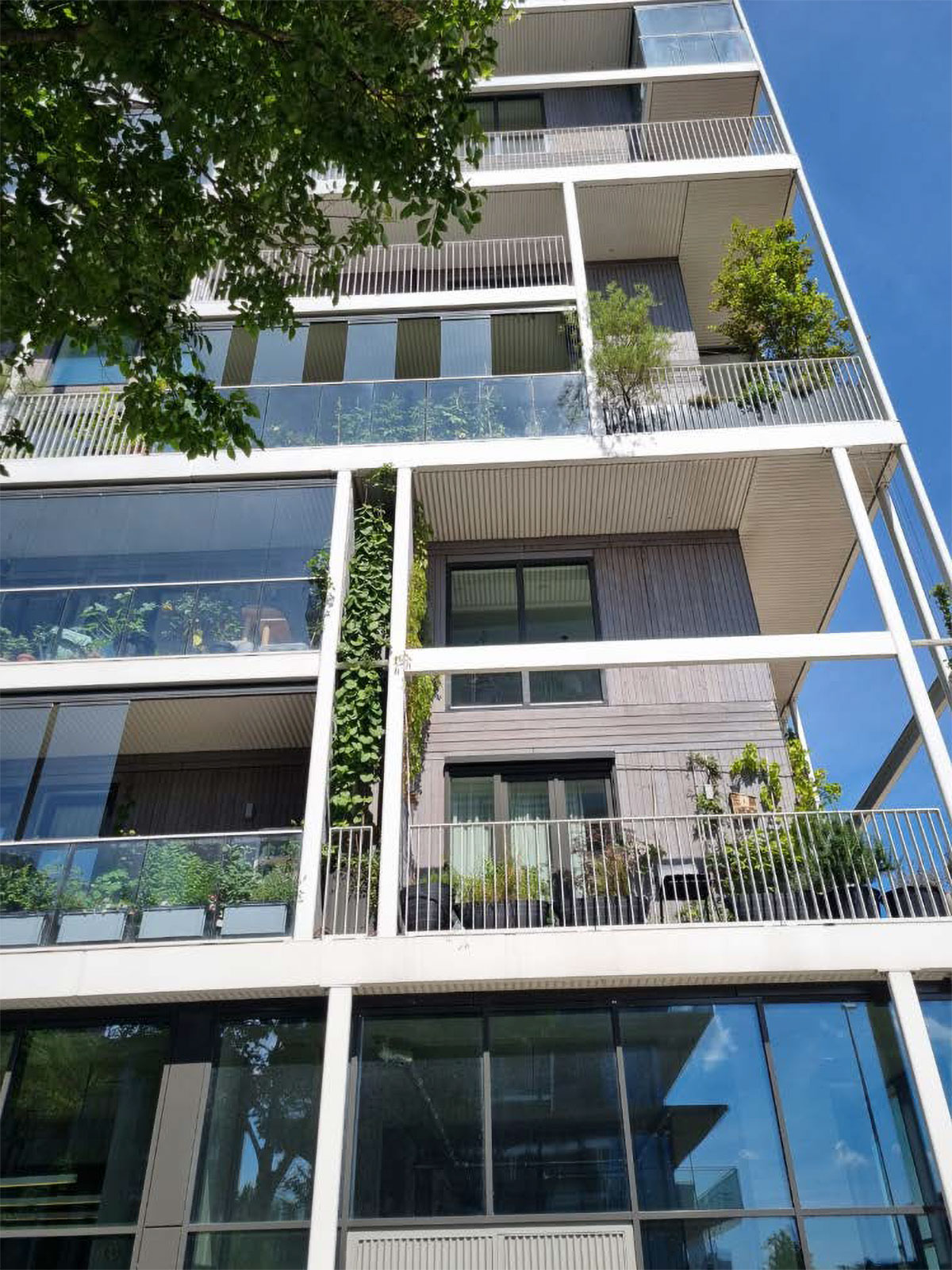
Planting designed into the facade of a residential building in Noord, Amsterdam
Conclusion
Amsterdam demonstrates that Urban Greening can transform a city and this is achievable when it is embedded into action through with clear principles, simple policies, and values that are shared widely. It is this alignment of policy, design, and community action, that has transformed Amsterdam’s streets, buildings, and neighbourhoods into productive, ecological rich social infrastructure.
Amsterdam has planted for the future, paying forward to the generations to come, it views Urban Greening as an infrastructure and as a long-term investment for urban sustainability. Through the provision of new street trees future shading and cooling will be achieved to reduce the urban heating and reduce energy demand for summer cooling. Surface water flooding will become more manageable with the widespread use of permeable paving for it’s streets and footpaths. Air quality will be improved as particulates are filtered out by the planting and then washing away.
Amsterdam’s residents have reclaimed their neighbourhoods; they have been empowered to form an army of green volunteers fostered pride and ownership of the city. Amsterdam as a city has become a cleaner, more loved and interesting place to live. It is steps ahead in planning for the future and caring for the environment than the UK. From building design, transport, and re-greening initiatives, Amsterdam shows what’s possible when citizens are empowered to regain ownership of their built environment and that putting people at the centre of environmental change is a powerful and successful approach to evoke change.
Urban Greening should not be a bureaucratic exercise, but a collective act of care for place.
The UK Planning Policy Manifesto (2021 and 2024 updates) calls for planning reforms to deliver sustainable cities. This could be achieved if we can learn from Amsterdam approach to Urban Green and integrate it into our national and local polices. It should become the focus for the regeneration of our towns and cities; Urban Green should be the norm — not the exception.
Proposals for the UK
What we can can learn from Amsterdam’s experience is that Urban Greening is not driven by extensive regulation, but by clarity, simplicity, and trust. To replicate similar outcomes, we could adopt the following changes.
1. Introduce a “Green by Default” Planning Principle
UK planning policy should presume Greening as standard practice.
- Embed a “Green by Default” principle within the National Planning Policy Framework.
- Require planting or biodiversity enhancements for all developments unless clearly unfeasible by establishing a minimum BNG value.
- Apply this principle to retrofit, highway works, and public-realm projects—not just new development.
2. Enhance the Biodiversity Net Gain policy for Urban Areas
While ambitious, BNG implementation is often underperforming in an urban context, it should be an opportunity for improvement, not proof that no biodiversity enhancement is required.
- Introduce a minimum BNG requirement for all sites so that the development of biodiverse poor brownfield and retrofit sites have to achieve a higher standard than the current system requires.
- Off-site BNG units to be transferred into a national BNG Credits Bank so that they can be spent in the most biodiverse poor areas.
3. Incentivise Integrated Green Architecture
Greening is most effective when designed into a development from the outset.
- Offer council tax and business rates discounts for buildings with green roofs and planted facades.
- Fast-track planning approvals for schemes exceeding a BNG 20% improvement over the benchmark.
- Publish clear national guidance on fire safety and maintenance for living walls and planted facades
- Introduce planning polices requiring planting spaces for residents, eg balcony gardens, window boxes or allotments.
4. Enable Citizen-Led Greening
Community participation should be actively supported by councils and landlords.
- Introduce a statutory “Right to Green” to allow residents to plant their balconies, communal spaces, streets and verges.
- Provide ring-fenced funding for free or subsidised trees and climbers to be given out to residents of urban areas.
- Replace restrictive public-realm controls with default permissions for residents to take ‘ownership’ of their streets and public spaces and install planting and shared spaces.
5. Re-prioritise Streets as Green Infrastructure
Streets are the UK’s have a huge potential for Greening.
- Mandate tree planting and permeable surfaces in highway works or renewal schemes.
- Allow parking reduction in favour of planting without the requirement for consultation and approvals.
- Councils to produce Green Connection Plans that will integrate biodiverse rich green corridors into towns and cities at connecting homes to parks.
6. Shift Landscape Standards Toward Biodiversity
- Update landscape guidance for both new and existing spaces to prioritise ecological performance over neatness, security and low maintenance.
- Encourage wildflower meadows and native planting in parks, verges, roundabouts and new green connections.e.
- Explicitly recognise grass monoculture as low-value land.e.
7. Treat Urban Greening as Long-Term Investment
- Designate Urban Greening as a Community Infrastructure and raise funds from CIL payments due on new developments
- Require long-term green infrastructure strategies aligned with climate adaptation.
- Treat trees and planting as long-term civic assets, not short-term costs.
- Set national targets for the planting of urban street trees.
- Extend Tree Protection orders to all street trees so that they cannot be removed without planning permission.
Amsterdam City Council’s Comprehensive Green Infrastructure Vision for 2050
The City Council’s Comprehensive Green Infrastructure Vision for 2050 sets four principal objects
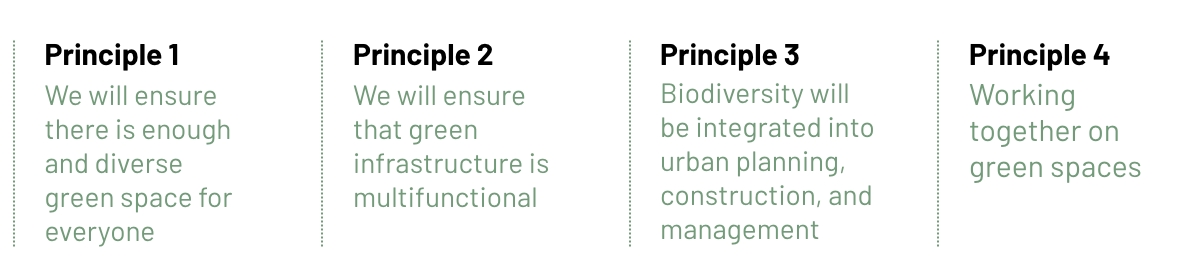
The four principles set out in the Comprehensive Infrastructure Vision for 2025
To achieve these, they have –
- Formed green neighbourhoods
- Designed greenways routes so that the cities residents are within 10 minute-walk to a park
- Linking their neighbourhood parks to larger public parks on the outside of the city
- Trading vehicular space for planting
- Promoted green buildings and green neighbourhoods
- Encouraged public action
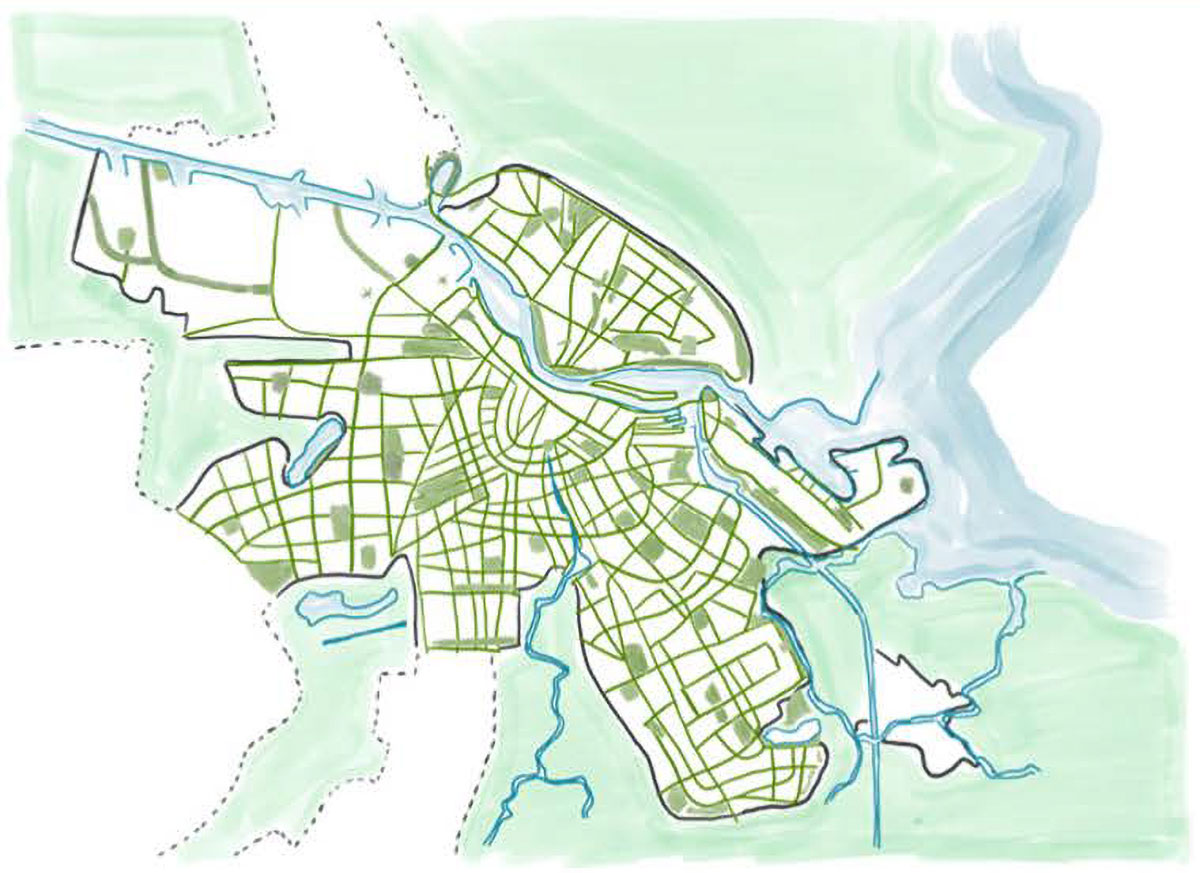
Diagram of green Links and new parks in Amsterdam
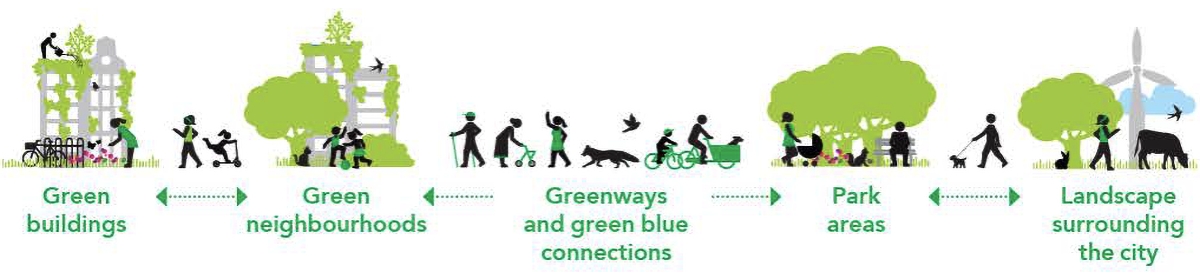
Diagram of green Links and new parks in Amsterdam
Examples of Urban Greening
An example of a new Green Link, above, Daniel Street in 2008 dominated by car parking and below in 2019 turn into a one-way street with the space gained used for planting and cycle stands.
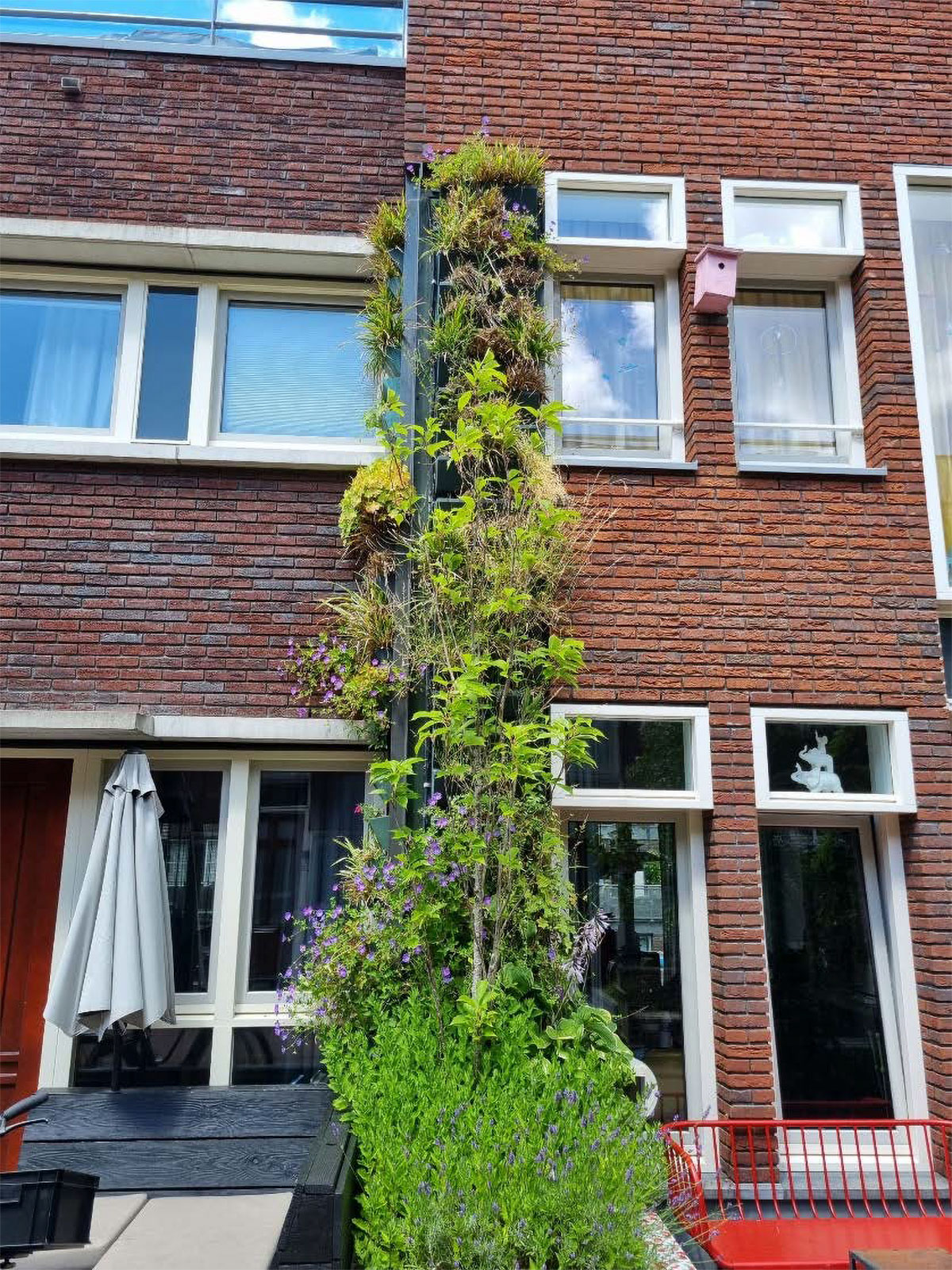
Planted façade to new housing
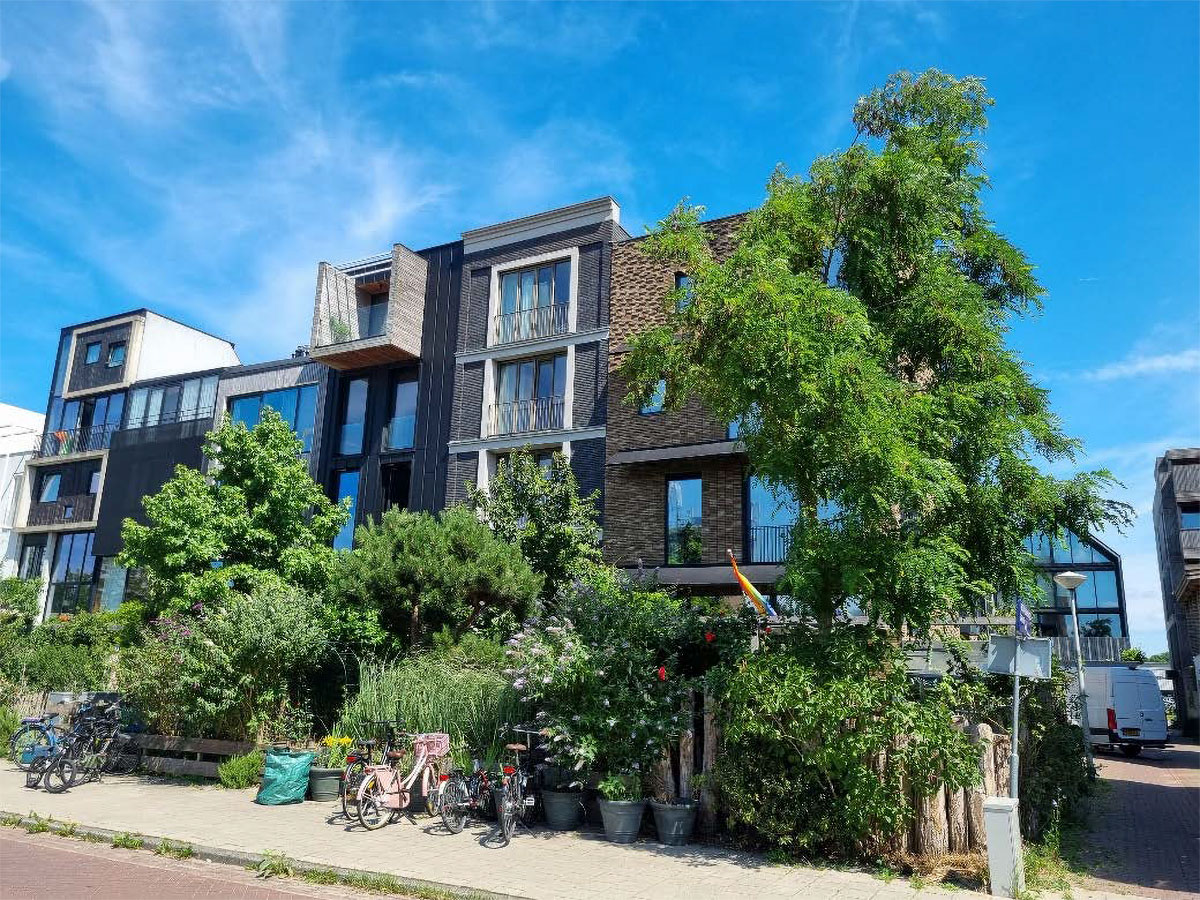
Natural planting to front gardens giving a rich habitat for insects and birds.
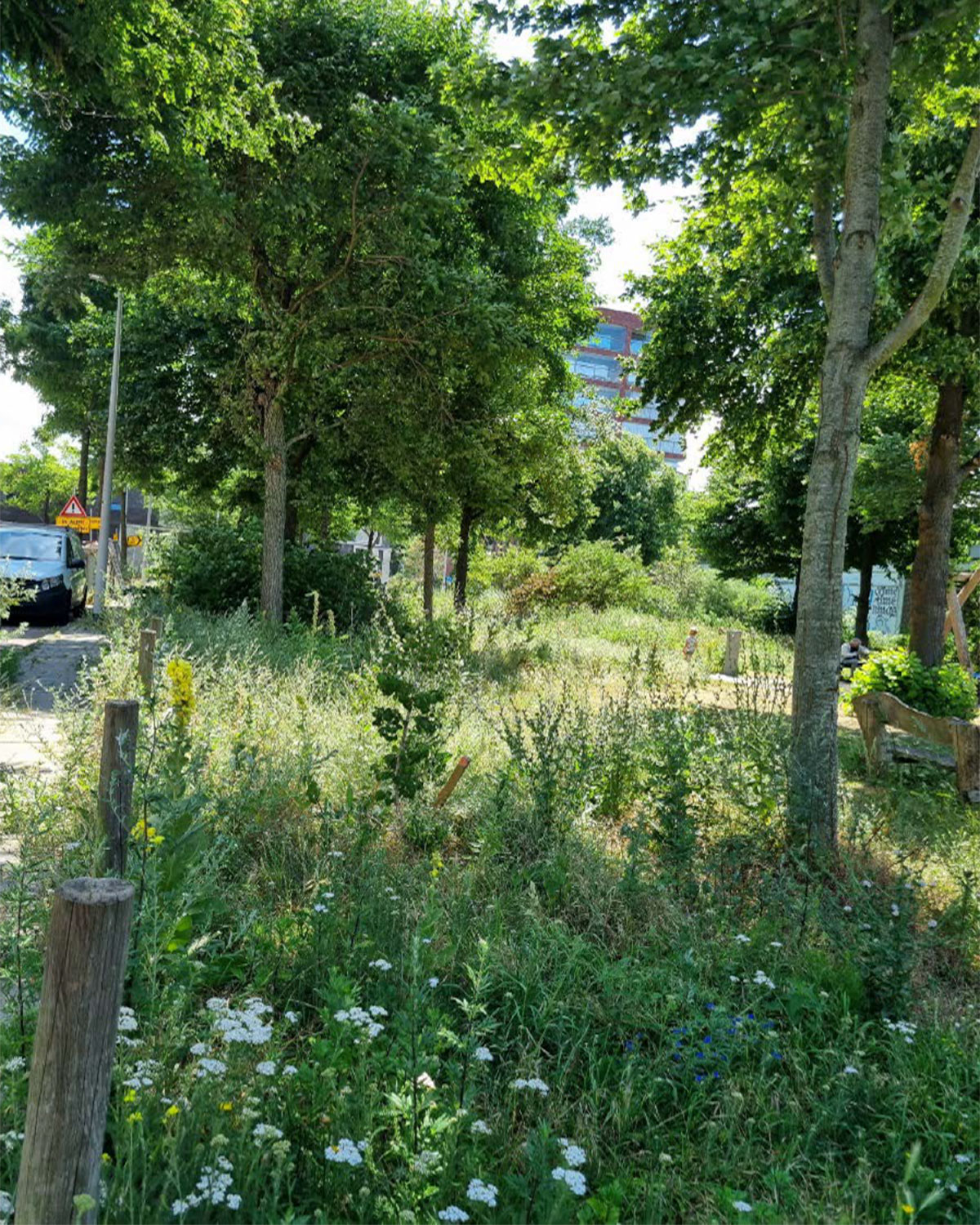
A Green Link in Noord connecting the regeneration area to the historic city centre, note the wild planting with flowers and ‘weeds’.
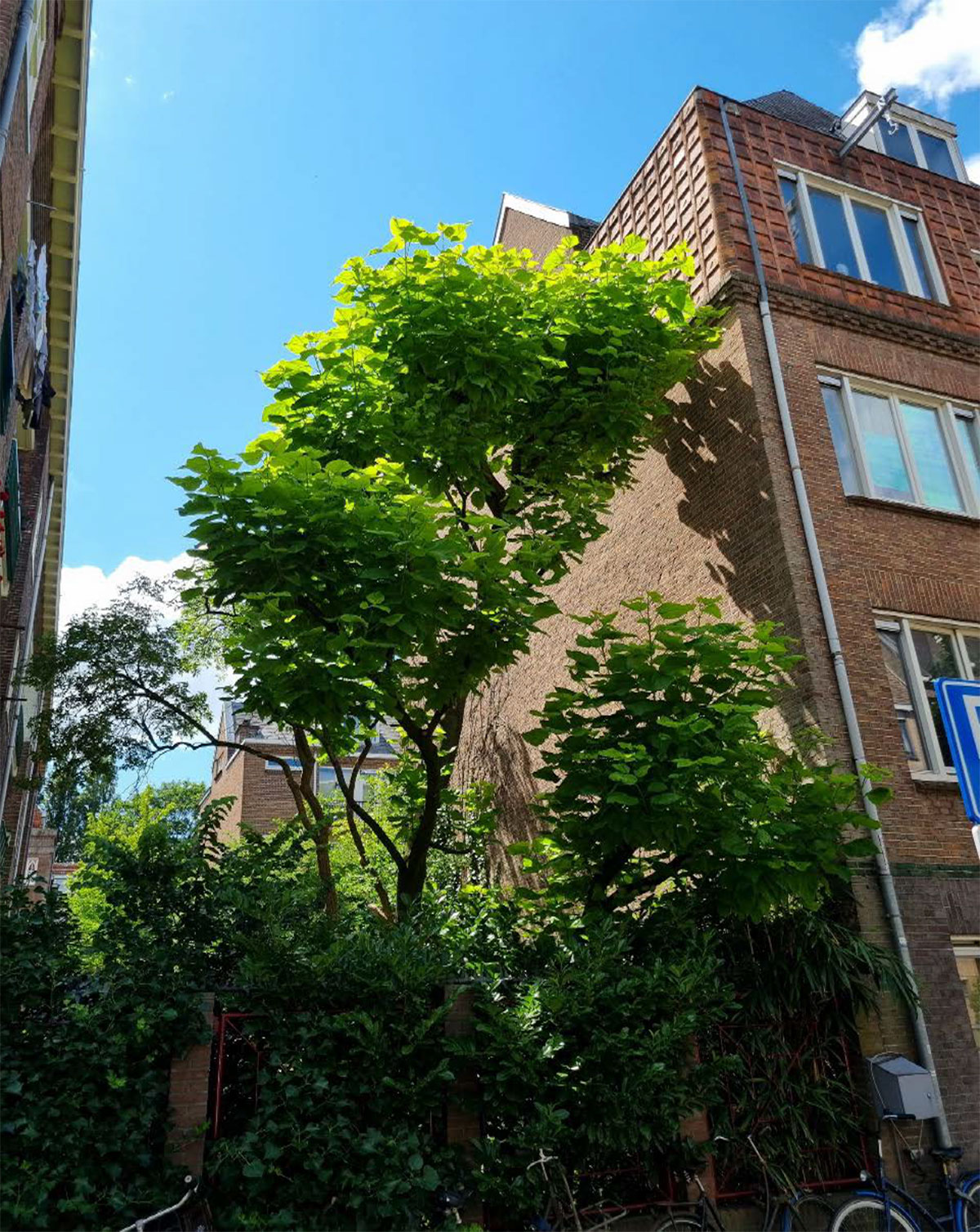
Planting between buildings in the historic centre
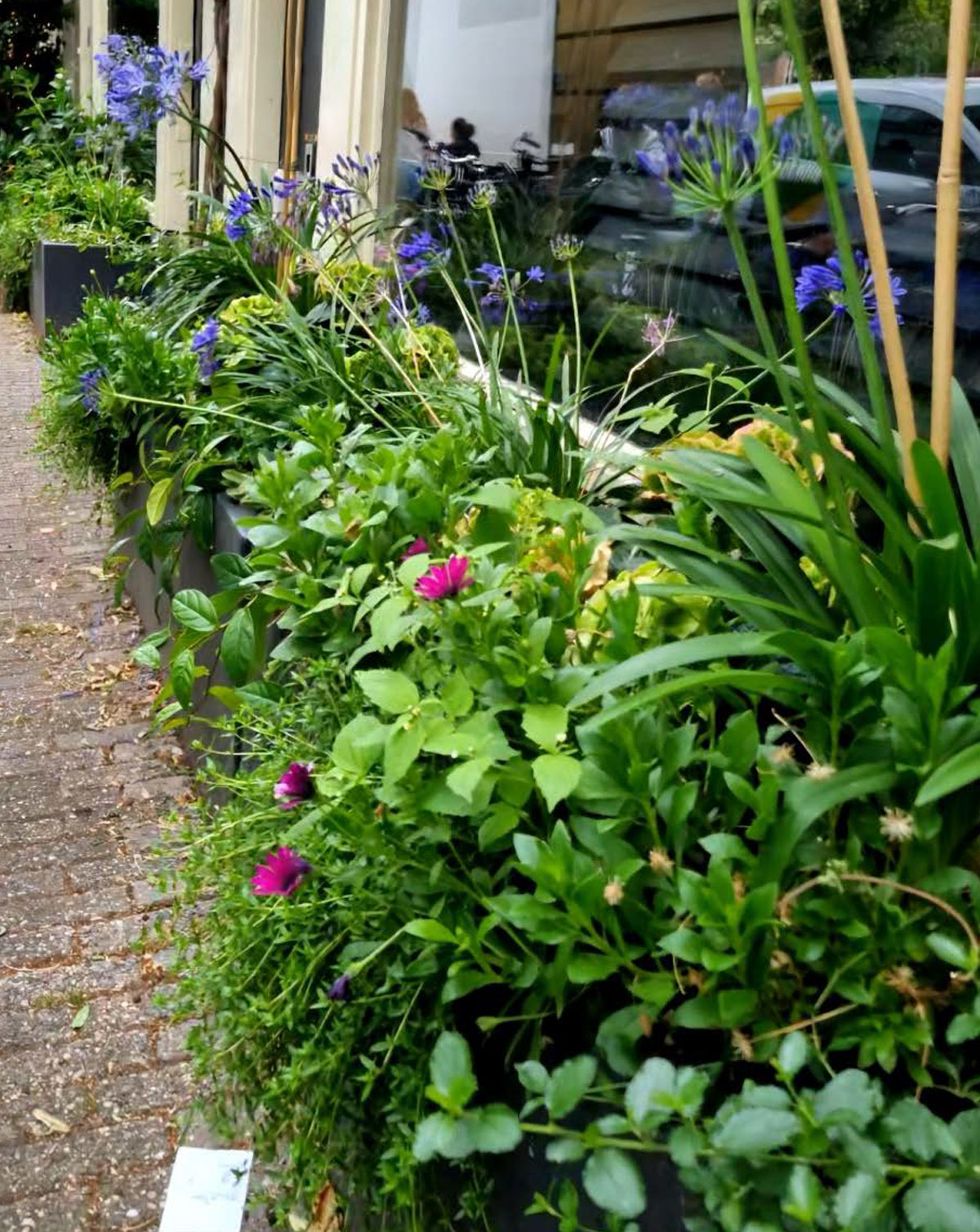
Planting by residents on the pavement
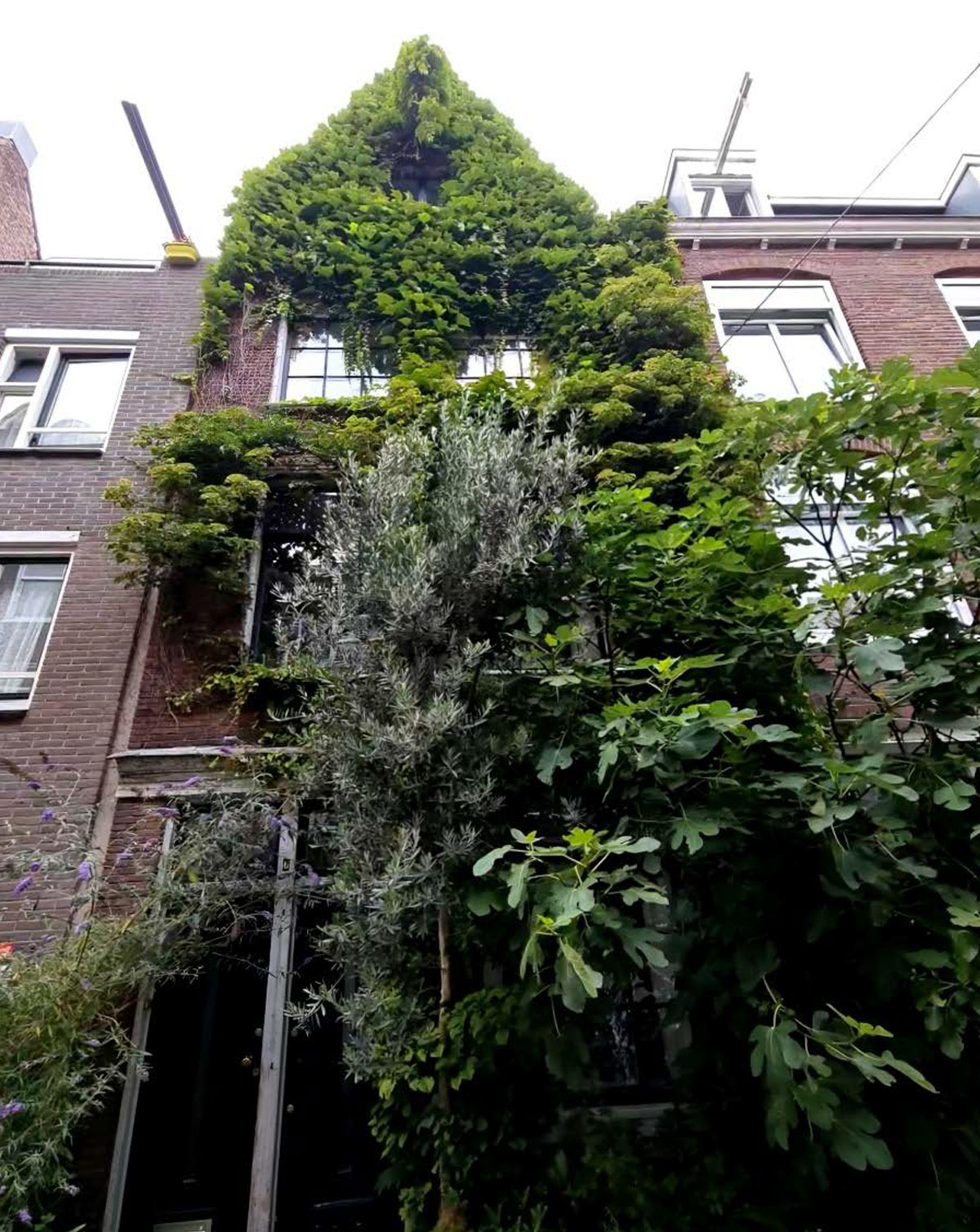
Climbers and planting to a house in the historic centre
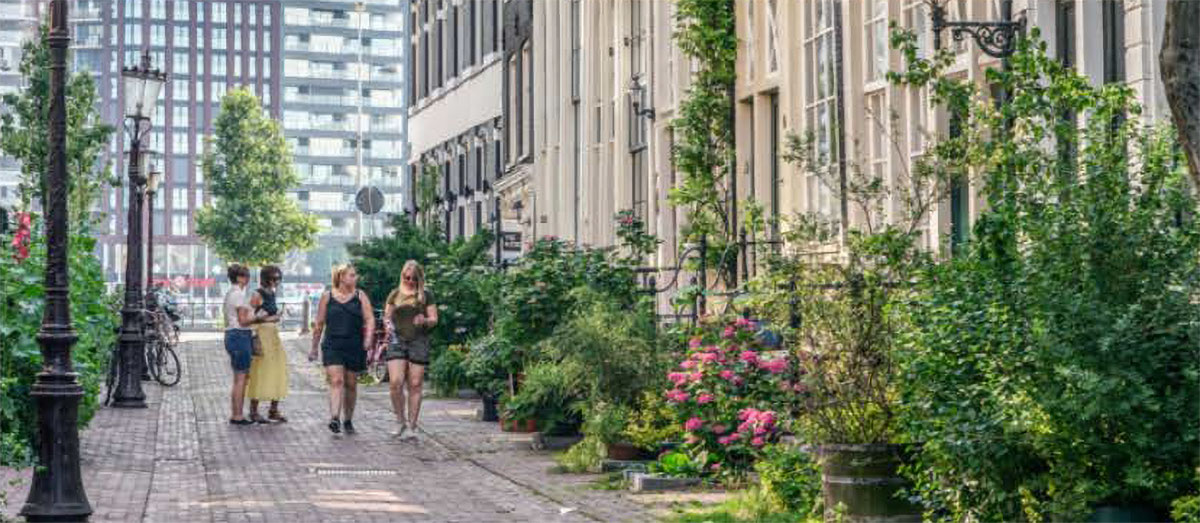
Car free street taken over by the residents
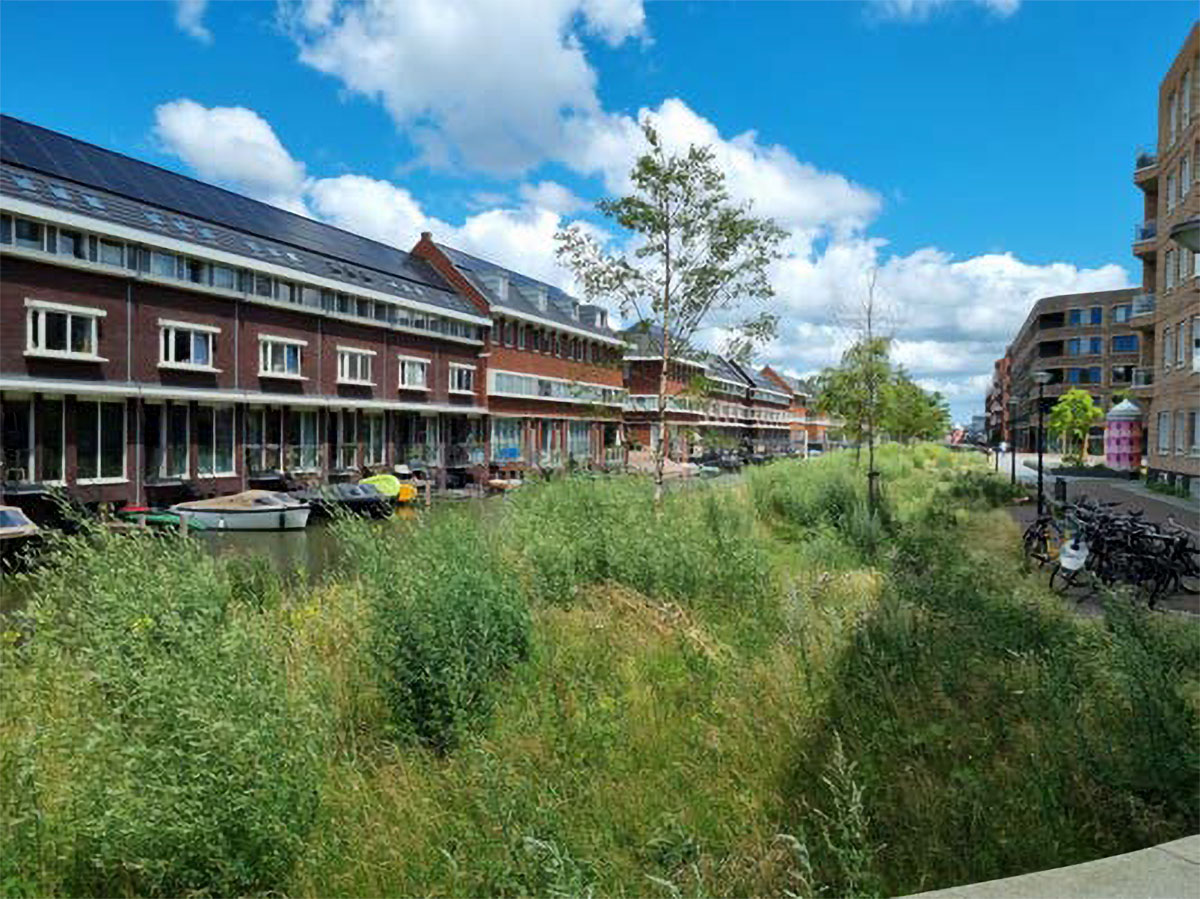
Space between new residential developments given over to wild planting
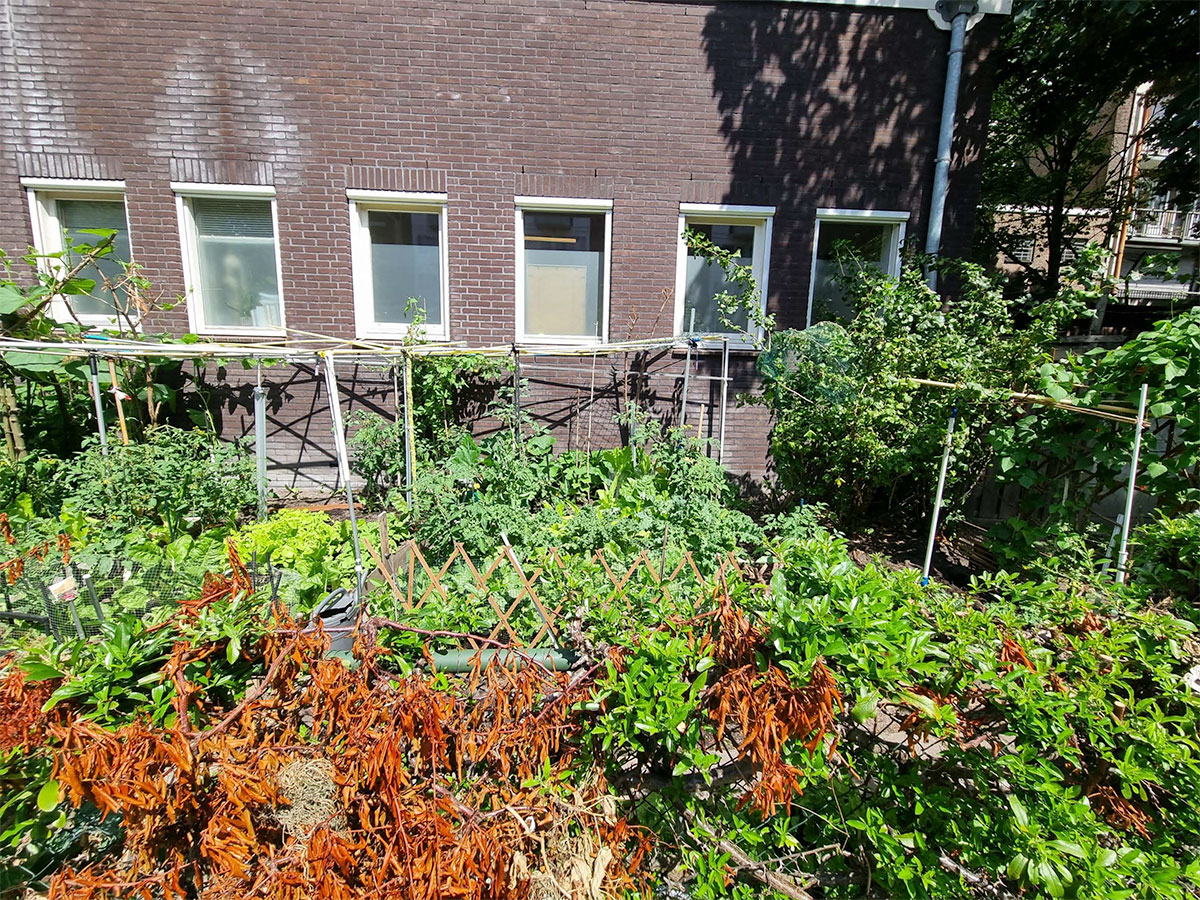
Common area to apartments divided into allotments
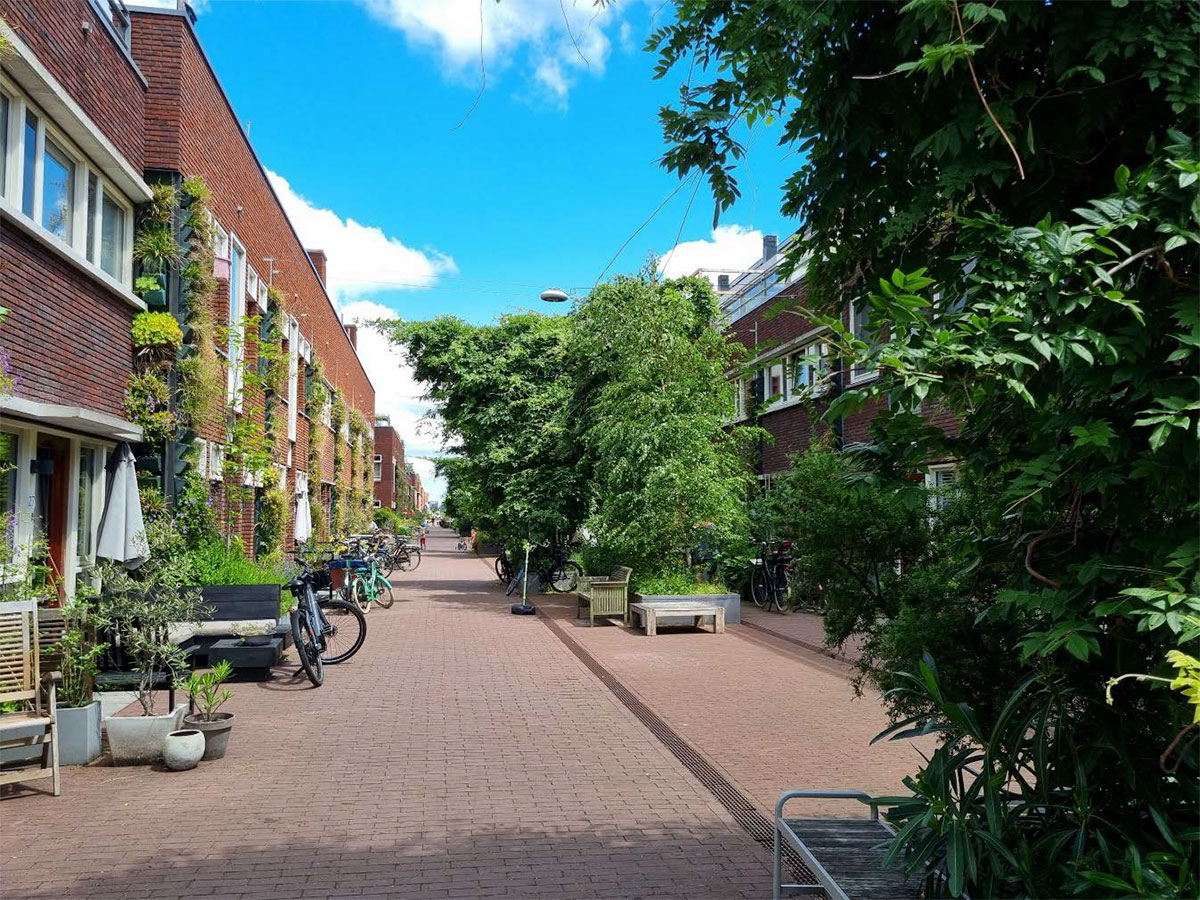
New car free residential street, the frontages to the houses being taken over by the residents with pots, chairs and tables.
Authors
Darren Bland B. Sc B. Arch RIBA
Freya Hennessey B.A